MCQ
$C{H_3} - C{H_2} - C \equiv CH\mathop {\xrightarrow{R}}\limits_{{H_2}O} $  Butanone, $R$ is
  • $H{g^{ + + }}$
  • B
    $KMn{O_4}$
  • C
    $KCl{O_3}$
  • D
    ${K_2}C{r_2}{O_7}$

Answer

Correct option: A.
$H{g^{ + + }}$
a
(a) It is hydration of alkynes.

$C{H_3} - C{H_2} - C \equiv CH\mathop {\xrightarrow{{H{g^{ +  + }}}}}\limits_{{H_2}O} \mathop {C{H_3} - C{H_2} - \mathop {\mathop C\limits^{||} }\limits^O  - C{H_3}}\limits_{{\text{Butanone}}} $


Need a full question paper?

Generate a complete, print-ready paper with questions like this in minutes — across 16+ boards, with answer keys.
Start Generating Free

Similar questions

The reaction is $C{H_3}CH = C{H_3}\mathop {\xrightarrow{{CO + {H_2}O}}}\limits_{{H^ + }} $  $\begin{array}{*{20}{c}}
  {C{H_3} - CH - C{H_3}} \\ 
  {|\,\,\,\,\,} \\ 
  {\,\,\,\,\,\,\,\,COOH} 
\end{array}$ known as
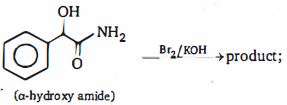
Product of this Hoffmann bromamide reaction is
$0.5\,M$  of ${H_2}S{O_4}$ is diluted from $1\,litre$ to $10\,litre$, normality of resulting solution is ......... $N$.
The value of osmotic pressure of a $ 0.2\,M$  aqueous solution at $293\,K$  is ........... $atm$
The negative ligand is
The element having electronic configuration belongs to $n{s^2}(n - 1){d^{1 - 10}}(n - 2){f^{1 - 14}}$
The difference in electronegativity of carbon-halogen bond is minimum in:
The complex with a maximum number of stereoisomers is
$150\,g$ of acetic acid was contaminated with $10.2\,g$ ascorbic acid $\left( C _{6} H _{8} O _{6}\right)$ to lower down its freezing point by $\left( x \times 10^{-1}\right)^{\circ} C$. The value of $x$ is (Nearest integer) [Given $K _{ f }=3.9\,K\,kg\,mol ^{-1}$;Molar mass of ascorbic acid $=176\,g\,mol ^{-1}$ ]
A trinitro compound, $1, 3,5$ tris-($4$-nitrophenyl) benzene, on complete reaction with an excess of $\mathrm{Sn} / \mathrm{HCl}$ gives major product, which on treatment with an excess of $NaNO_2 /  HCl$ at $0^{\circ} C$ provides $P$ as the product. $P$, upon treatment with excess of $H_2 O$ at room temperature, gives the product $Q$. Bromination of $Q$ in aqueous medium furnishes the product $R$. The compound $P$ upon treatment with an excess of phenol under basic conditions gives the product $S$.

The molar mass difference between compounds $Q$ and $R$ is $474 \mathrm{~mol}^{-1}$ and between compounds $P$ and $S$ is $172.5 \mathrm{~g} \mathrm{~mol}^{-1}$.

($1$)The number of heteroatoms present in one molecule of $R$ is. . . . .  .

[Use: Molar mass (in g mol ${ }^{-1}$ ): $\mathrm{H}=1, \mathrm{C}=12, \mathrm{~N}=14, \mathrm{O}=16, \mathrm{Br}=80, \mathrm{Cl}=35.5$

Atoms other than $\mathrm{C}$ and $\mathrm{H}$ are considered as heteroatoms]

($2$)The total number of carbon atoms and heteroatoms present in one molecule of $S$. . . . . .

[Use: Molar mass in $\mathrm{g} \mathrm{mol}^{-1}$ ]: $\mathrm{H}=1, \mathrm{C}=12, \mathrm{~N}=14, \mathrm{O}=16, \mathrm{Br}=80, \mathrm{Cl}=35.5$

Atoms other than $\mathrm{C}$ and $\mathrm{H}$ are considered as heteroatoms

Give the answer quetion ($1$) and ($2$)