MCQ
Change in entropy is positive for
  • A
    $H_2O_{(g)} \longrightarrow H_2O_{(l)}$
  • B
    $H_2O_{(l)} \longrightarrow H_2O_{(s)}$
  • C
    ${N_2} + 3{H_2}  \longrightarrow 2N{H_3}$
  • $2O_{3(g)} \longrightarrow 3O _{2(g)}$

Answer

Correct option: D.
$2O_{3(g)} \longrightarrow 3O _{2(g)}$
d

Need a full question paper?

Generate a complete, print-ready paper with questions like this in minutes — across 16+ boards, with answer keys.

Start Generating Free

Similar questions

If $4.0 \,gm $ $NaOH$ is present in $1$ litre solution, then its $pH$ will be
Which acid can be oxidised be Fehling solution:
Identify wrong statement

$\begin{array}{*{20}{c}}
  {C{H_3} - CH - CH = C{H_3}} \\ 
  {|\,\,\,\,\,\,\,\,\,\,\,\,\,\,\,\,\,} \\ 
  {C{H_3}\,\,\,\,\,\,\,\,\,\,\,\,} 
\end{array}\xrightarrow{{HBr}}A$

$\begin{array}{*{20}{c}}
  {C{H_3} - CH - CH = C{H_3}} \\ 
  {|\,\,\,\,\,\,\,\,\,\,\,\,\,\,\,\,\,} \\ 
  {C{H_3}\,\,\,\,\,\,\,\,\,\,\,\,} 
\end{array}\xrightarrow{{HBr + ROOR}}B$

$\begin{array}{*{20}{c}}
  {C{H_3} - CH - CH = C{H_3}} \\ 
  {|\,\,\,\,\,\,\,\,\,\,\,\,\,\,\,\,\,} \\ 
  {C{H_3}\,\,\,\,\,\,\,\,\,\,\,\,} 
\end{array}\xrightarrow{{NBS}}C$

The following square - planar complex shows cis - trans isomerism
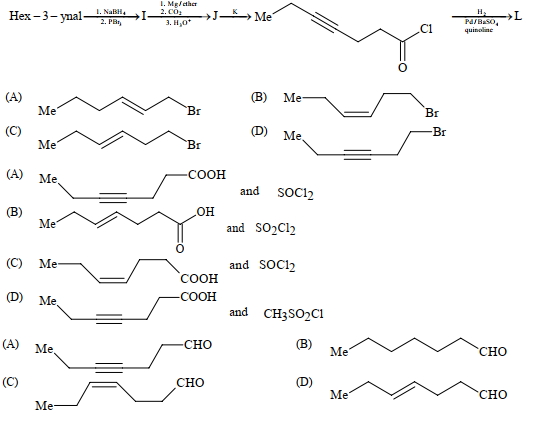
In the following sequence, products $\mathrm{I}, \mathrm{J}$ and $\mathrm{L}$ are formed. $\mathrm{K}$ represents a reagent.

$Image$

$1.$ The structure of the product $\mathrm{I}$ is

A,B,C,D,  $Image$

$2.$ The structures of compounds $J$ and $K$ respectively are

A,B,C,D,  $Image$

$3.$ The structure of product $L$ is

A,B,C,D,  $Image$

Give the answer question $1,2$ and $3.$
Using anhydrous $AlC{l_3}$ as catalyst, which one of the following reaction produces ethylbenzene $(PhEt)$
Which of the following gives most stable carbocation by dehydration
Acetone is mixed with bleaching powder to give
Solubility of a salt ${M_2}{X_3}$ is $y\,\,mol\,d{m^{ - 3}}.$ The solubility product of the salt will be
The energy of an electron in the first Bohr’s orbit of $H$ atom is $-13.6\,eV.$ The possible energy value (s) of the excited state (s) for electron in Bohr’s orbits of hydrogen is (are) : ............. $\mathrm{eV}$