MCQ
Change in temperature of the medium changes:
  • A
    Frequency of sound waves.
  • B
    Amplitude of sound waves.
  • C
    Wavelength of sound waves.
  • D
    Loudness of sound waves.

Answer

  1. Wavelength of sound waves.

Explanation:

Speed of sound wave in amedium $\text{v}=\sqrt{\frac{\gamma\ \text{RT}}{\text{M}}}.$ here $\gamma,\text{R}$ and M are constent.

Hence, $\text{v}\propto\sqrt{\text{T}}$ (where T is tempreature of the medium)

It mence when temprature changes, speed also changes.

As, $\text{v}=\text{f}\lambda,$ where f is frequency and $\lambda$ is wavelength.

As frequency (f) remains fixed, $\text{v}\propto\lambda$ or $\lambda$ hence wavelength $(\lambda)$changes.

Hence verifies the option (c).

Need a full question paper?

Generate a complete, print-ready paper with questions like this in minutes — across 16+ boards, with answer keys.

Start Generating Free

Similar questions

Two sphere of mass $m$ and $M$ are situated in air and the gravitational force between them is $F$. The space around the masses is now filled with a liquid of specific gravity $3$. The gravitational force will now be
At which of the following temperatures, the value of surface tension of water is minimum ....... $^oC$
Consider following statements

$[1]$ $CM$ of a uniform semicircular disc of radius $R = 2R/\pi$ from the centre

$[2]$ $CM$ of a uniform semicircular ring of radius $R = 4R/3 \pi$ from the centre

$[3]$ $CM$ of a solid hemisphere of radius $R = 4R/3 \pi$ from the centre

$[4]$ $CM$ of a hemisphere shell of radius $R = R/2$ from the centre Which statements are correct?
A thin metal disc of radius of $0.25\,m$ and mass $2\,kg$ starts from rest and rolls down on an inclined plane. If its rotational kinetic energy is $4\,J$ at the foot of inclined plane, then the linear velocity (in $m/s$) at the same point is
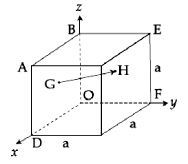
In the cube of side $a$ shown in the figure, the vector from the central point of the face $ABOD$ to the central point of the face $BEFO$ will be
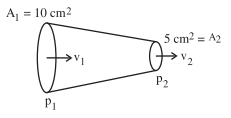
Glycerine of density $1.25 \times 10^3\,kg\,m ^{-3}$ is flowing through the conical section of pipe. The area of cross-section of the pipe at its ends is $10\,cm ^2$ and $5\,cm ^2$ and pressure drop across its length is $3\,Nm ^{-2}$. The rate of flow of glycerine through the pipe is $x \times 10^{-5} m ^3 s ^{-1}$. The value of $x$ is $..............$.
In a streamline flow:
  1. The speed of a particle always remains same.
  2. The velocity of a particle always remains same.
  3. The kinetic energies of all the particles arriving at a given point are the same.
  4. The momenta of all the particles arriving at a given point are the same.
A force of $(3\,\hat i + 4\,\hat j)$ Newton acts on a body and displaces it by $(3\,\hat i + 4\hat j)\,m.$ The work done by the force is .............. $\mathrm{J}$
The relationship between pressure and the density of a gas expressed by Boyle’s law, $ P = KD$ holds true
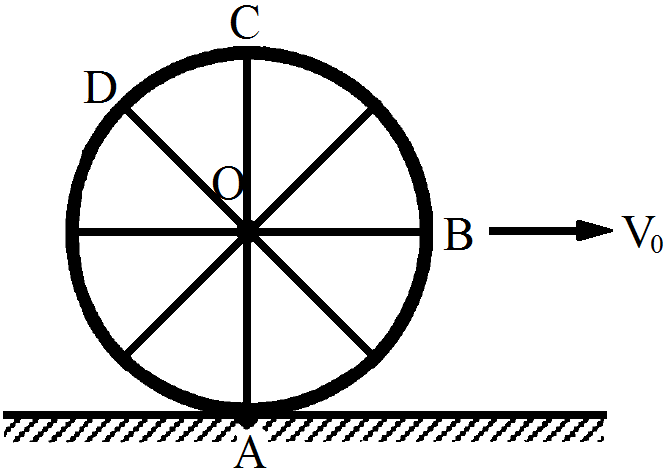
Consider a wheel of a bicycle rolling on a level road at a linear speed v0:

  1. The speed of the particle A is zero.
  2. The speed of B, C and D are all equal to v0.
  3. The speed of C is 2v0.
  4. The speed of B is greater than the speed of O.