MCQ
Charge motion within the Gaussian surface gives changing physical quantity:
- AElectric field.
- BElectric flux.
- CCharge.
- DGaussian surface area.
Generate a complete, print-ready paper with questions like this in minutes — across 16+ boards, with answer keys.
The cut-in voltage for silicon diode is approximately
| (a) 0.2 V | (b) 0.6 V | (c) 1.1 V | (d) 1.4 V |
Two heater wires of equal length are first connected in series and then in parallel. The ratio of heat produced in the two cases is
|
(a) 2 : 1 |
(b) 1 : 2 |
(c) 4 : 1 |
(d) 1 : 4 |
A battery of e.m.f. E and internal resistance r is connected to a variable resistor R as shown here. Which one of the following is true
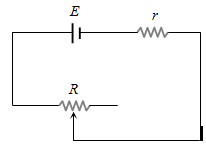
|
(a) Potential difference across the terminals of the battery is maximum when R = r |
|
(b) Power delivered to the resistor is maximum when R = r |
|
(c) Current in the circuit is maximum when R = r |
|
(d) Current in the circuit is maximum when R >> r |
The bending of light as it passes from one medium into another is commonly known as:
The working of dynamo is based on principle of
|
(a) Electromagnetic induction |
(b) Conversion of energy into electricity |
|
(c) Magnetic effects of current |
(d) Heating effects of current |
An electron (mass = 9.1  kg; charge = 1.6
  C) experiences no deflection if subjected to an electric field of 3.2
  V/m, and a magnetic fields of 2.0
  Wb/m2. Both the fields are normal to the path of electron and to each other. If the electric field is removed, then the electron will revolve in an orbit of radius
|
(a) 45 m |
(b) 4.5 m |
(c) 0.45 m |
(d) 0.045 m |
At the time of total solar eclipse, the spectrum of solar radiation would be
|
(a) A large number of dark Fraunhofer lines |
|
(b) A less number of dark Fraunhofer lines |
|
(c) No lines at all |
|
(d) All Fraunhofer lines changed into brilliant colours |