MCQ
Charge motion within the Gaussian surface gives changing physical quantity:
- AElectric field.
- BElectric flux.
- CCharge.
- DGaussian surface area.
Generate a complete, print-ready paper with questions like this in minutes — across 16+ boards, with answer keys.
Assertion : Electric appliances with metallic body have three connections, whereas an electric bulb has a two pin connection.
Reason : Three pin connections reduce heating of connecting wires.
|
(a) If both assertion and reason are true and the reason is the correct explanation of the assertion. |
|
(b) If both assertion and reason are true but reason is not the correct explanation of the assertion. |
|
(c) If assertion is true but reason is false. |
|
(d) If the assertion and reason both are false. |
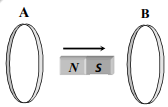
A convex mirror has a focal length f. A real object is placed at a distance f in front of it from the pole produces an image at
|
(a) Infinity |
(b) f |
(c) f/2 |
(d) 2f |
From the graph between current I and voltage V shown below, identify the portion corresponding to negative resistance

|
(a) AB |
(b) BC |
(c) CD |
(d) DE |
In photoelectric effect, the K.E. of electrons emitted from the metal surface depends upon
|
(a) Intensity of light |
(b) Frequency of incident light |
|
(c) Velocity of incident light |
(d) Both intensity and velocity of light |
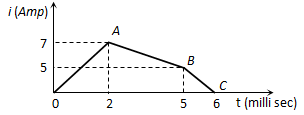
The current through a 4.6 H inductor is shown in the following graph. The induced emf during the time interval t = 5 milli-sec to 6 milli-sec will be
|
(a) 103 V |
(b) – 23 × 103 V |
(c) 23 × 103 V |
(d) Zero |