Question
Check the commutativity and associativity of the following binary operations:
'*' on Q defined by a * b = a - b for all a, b ∈ Q.

Answer

Commutativity: Let $\text{a, b}\in\text{Q.}$ Then,
a * b = a - b
b * a = b - a
Therefore,
$\text{a}\ ^*\ \text{b}\neq\text{b}\ ^*\ \text{a}$
Thus, * is not commutative on Q.
Associativity: Let $\text{a, b, c}\in\text{Q.}$ Then,
a * (b * c) = a * (b - c)
= a - (b - c)
= a - b + c
(a * c) * c = (a - b) * c
= a - b - c
Therefore,
$\text{a}\ ^*\ (\text{b}\ ^*\ \text{c})\neq(\text{a}\ ^*\ \text{b})\ ^*\ \text{c}$
Thus, * is not associative on Q.

Need a full question paper?

Generate a complete, print-ready paper with questions like this in minutes — across 16+ boards, with answer keys.
Start Generating Free

Similar questions

12 cards, numbered 1 to 12, are placed in a box, mixed up thoroughly and then a card is drawn at random from the box. If it is known that the number on the drawn card is more than 3, find the probability that it is an even number.
Show that the right circular cone of least curve surface and given volume has an altitude equal to $\sqrt{2}$ time the radius of the base.
An aeroplane can carry a maximum of 200 passengers. A profit of Rs.1000 is made on each executive class ticket and a profit of Rs.600 is made on each economy class ticket. The airline reserves atleast 20 seats for executive class. However, atleast 4 times as many passengers prefer to travel by economy class than by the executive class. Determine how many tickets of each type must be sold in order to maximise the profit of the airline. What is the maximum profit?
Evaluate the following integrals:
$\int\frac{1}{\text{x}^4+\text{x}^2+1}\ \text{dx}$
Solve the following system of equations by matrix method:$\frac{2}{\text{x}}-\frac{3}{\text{y}}+\frac{3}{\text{z}}=10$
$\frac{1}{\text{x}}+\frac{1}{\text{y}}+\frac{1}{\text{z}}=10$
$\frac{3}{\text{x}}-\frac{1}{\text{y}}+\frac{2}{\text{z}}=13$
Determine whether the following pair of lines intersect or not:
$\frac{\text{x}-1}{3}=\frac{\text{y}-1}{-1}=\frac{\text{z}+1}{0}$ and $\frac{\text{x}-4}{2}=\frac{\text{y}-0}{0}=\frac{\text{z}+1}{3}$
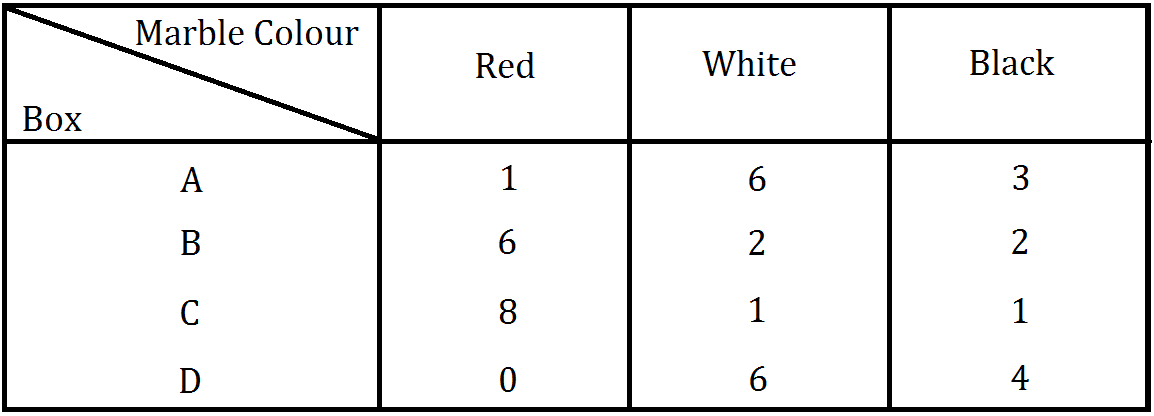
Suppose we have four boxes A, B, C, D containing coloured marbles as given below:
One of the boxes has been selected at random and a single marble is drawn from it. If the marble is red, what is the probability that it was drawn from,
  1. Box A?
  2. Box B?
  3. Box C?
A toy company manufactures two types of dolls, A and B. Market tests and available resources have indicated that the combined production level should not exceed 1200 dolls per week and the demand for dolls type B is at most half of that for dolls of types A. Further, the production level of dolls of type A can exceed three times the production of dolls of other type by at most 600 units. If the company makes profit of Rs. 12 and Rs. 16 per doll respectively on dolls A and B, how many of each should be produced weekly in order to maximize the profit ?
Differentiate $\tan^{-1}\Big(\frac{\text{x}-1}{\text{x}+1}\Big)$ with respect to $\sin^{-1}\big(3\text{x}-4\text{x}^3\big),$ if $-\frac{1}{2}<\text{x}<\frac{1}{2}$
Evaluate the following definite integrals:
$\int\limits_{0}^{1}\frac{1}{\sqrt{(\text{x}-1)(2-\text{x})}}\text{ dx}$