Question
Check whether $6^n$​​​​​​​ can end with the digit 0 for any natural number n.

Answer

If the number $6^n$ ends with the digit zero, then it is divisibli by $5$ .
Therefore the prime factorization of $6^n$ contains the prime $5$ .
This is not possible because the only prime in the factorisation of $6^n$ is $2$ and $3$ and the uniqueness of the fundamental theorem of arithmetic guarantees that these are no other prime in the factorisation of $6^{ n }$.
Hence it is very clear that there is no value of $n$ in natural numbers for which $6^n$ ends with the digit zero.

Need a full question paper?

Generate a complete, print-ready paper with questions like this in minutes — across 16+ boards, with answer keys.
Start Generating Free

Similar questions

Prove the following trigonometric identities.
$\text{cos}^2\text{A}+\frac{1}{1+\cot^2\text{A}}=1$
Metallic spheres of radii $6\ cm$, $8\ cm$ and $10\ cm$ respectively are melted to form a single solid sphere. Find the radius of the resulting sphere.
Show that the roots of the equation $x^2 + px - q^2 = 0$ are real for all real value of p and q.
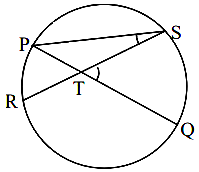
In the figure, if the chord $P Q$ and chord $R S$ intersect at point $T$, prove that: $m \angle S T Q=\frac{1}{2}[m(\operatorname{arc} P R)+$ $m (\operatorname{arc} S Q)]$ for any measure of $\angle S T Q$ by filling out the boxes

Proof: $m \angle STQ = m \angle SPQ +\square \ldots$....[Theorem of the external angle of a triangle $]$ $=\frac{1}{2} m (\operatorname{arc~SQ})+\square \quad \ldots . . .[$ Inscribed angle theorem $]$
$=\frac{1}{2}[\square+\square]$
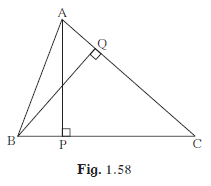
In ΔABC, AP ⊥ BC, BQ ⊥ AC B- P-C, A-Q - C then prove that, ΔCPA ~ ΔCQB. If AP = 7, BQ = 8, BC = 12 then find AC.
Which of the following are quadratic equations?
$3x^2 - 5x + 9 = x^2 - 7x + 3$
$\triangle \mathrm{ABC} \sim \triangle \mathrm{PQR}, \mathrm{A}(\triangle \mathrm{ABC})=16, \mathrm{~A}(\triangle \mathrm{PQP})=25$, then find the value of ratio $\frac{\mathrm{AB}}{\mathrm{PQ}}$.
Find the coordinates of the point P which divides line segment QR in the ratio m : n in the following examples.
(i) $Q (-5,8), \quad R (4,-4) \quad m: n=2: 1$
(ii) $Q (-2,7), \quad R (-2,-5) \quad m: n=1: 3$
(iii) $Q (1,7), \quad R (-3,1) \quad m: n=1: 2$
(iv) $Q (6,-5), \quad R (-10,2) \quad m: n=3: 4$
(v) $Q (5,8), \quad R (-7,-8) \quad m: n=4: 1$
The probability of selecting a ratten apple randomly from a heap of 900 apples is 0.18. What is the number of rotten apples in the heap?
Find the largest number which divides $438$ and $606$, leaving remainder $6$ in each case.