MCQ
Choose the correct answer from the given four options. The feasible solution for a LPP is shown in. Let Z = 3x - 4y be the objective function.
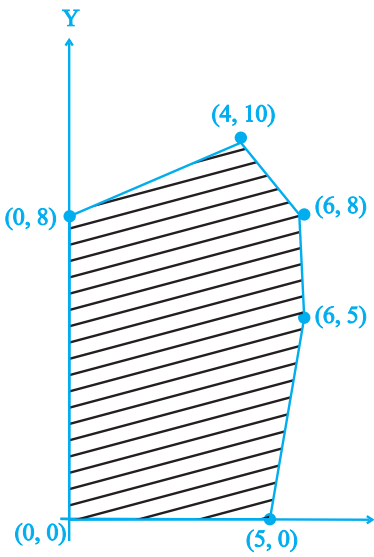
Maximum of Z occurs at:
  • (5, 0)
  • B
    (6, 5)
  • C
    (6, 8)
  • D
    (4, 10)

Answer

Correct option: A.
(5, 0)
 
Corner points
Corresponding value of Z = 3x - 4y
(0, 0)
(5, 0)
(6, 5)
(6, 8)
(4, 10)
(0, 8)
0
15 (Maxmimum)
-2
-14
-28
-32
Hence, maximum of Z occurs at (5, 0) and its maximum value is 27.

Need a full question paper?

Generate a complete, print-ready paper with questions like this in minutes — across 16+ boards, with answer keys.

Start Generating Free

Similar questions

Choose the correct answer in Exercise : $\int\frac{\text{dx}}{\text{e}^{\text{x}}+\text{e}^{-\text{x}}}$ is equal to
$\cos[\tan^{-1}\{\sin(\cot^{-1}\text{x})\}]$ is equal to:
Let $y=y(x)$ be the solution of the differential equation $\frac{ dy }{ dx }=\frac{4 y ^{3}+2 yx ^{2}}{3 xy ^{2}+ x ^{3}}, y (1)=1$. If for some $n \in N , y (2) \in[ n -1, n )$, then $n$ is equal to $\dots\dots$
If the function  $f(x) =  - 4{e^{\left( {\frac{{1 - x}}{2}} \right)}} + 1 + x + \frac{{{x^2}}}{2} + \frac{{{x^3}}}{3}$ and $g(x)=f^{-1}(x) \,;$ then the value of $g'(-\frac{7}{6})$ equals
If G is the set of all matrices of the form $\begin{bmatrix}\text{x}&\text{x}\\\text{x}&\text{x}\end{bmatrix}$, where $\text{x}\in\text{R}-\{0\}$, then the identity element with respect to the multiplication of matrices as binary operation, is:
Let $R= \{(3, 3) (5, 5), (9, 9), (12, 12), (5, 12), (3, 9), (3, 12), (3, 5)\}$ be a relation on the set $A= \{3, 5, 9, 12\}.$ Then, $R$ is
A real valued function $y = f(x)$ satisfies the relation $f\left( {x - \frac{4}{9}} \right) + 2x \le \frac{9}{4}{x^2} + \frac{8}{9} \le f\left( {x + \frac{4}{9}} \right) - 2x$ . The value of $f\ ''(2)$ is
If $\text{x}=\text{a}\cos^3\theta,\text{y}=\text{a}\sin^3,$ then $\sqrt{1+\Big(\frac{\text{dy}}{\text{dx}}\Big)^2}=$
Let $X=\left\{(x, y) \in \mathbb{Z} \times \mathbb{Z}: \frac{x^2}{8}+\frac{y^2}{20}<1\right.$ and $\left.y^2<5 x\right\}$. Three distinct points $P, Q$ and $R$ are randomly chosen from $X$. Then the probability that $P, Q$ and $R$ form a triangle whose area is a positive integer, is
Choose the correct answer:$\text{Let}\ \vec{\text{a}}\ \text{and}\ \vec{\text{b}}$ be two unit vectors and $\theta$ is the angle between them. Then $\vec{\text{a}}+\vec{\text{b}}$ is a unit vector if,