MCQ
Choose the correct answer from the given four options:The interval on which the function $f(x) = 2x^3 + 9x^2 + 12x - 1$ is decreasing is:
  • A
    $[-1,\infty)$
  • $[-2,-1]$
  • C
    $(-\infty ,-2]$
  • D
    $[-1,1]$

Answer

Correct option: B.
$[-2,-1]$
We have, $f(x) = 2x^3 + 9x^2 + 12x - 1$
$\therefore f\ '(x) = 6x^2 + 18x + 12$
$= 6(x^2 + 3x + 2) = 6(x + 2)(x + 1)$
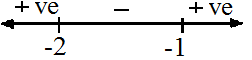
So, $\text{f}\ '(\text{x})\leq0,$ for decreasing.
On drawing number lines as below.

We see that $f\ '(x)$ is decreasing in $[-2, -1].$

Need a full question paper?

Generate a complete, print-ready paper with questions like this in minutes — across 16+ boards, with answer keys.

Start Generating Free

Similar questions

The set of points where the function $f(x) = x |x|$ is differentiable is:
If $\text{A}=\displaystyle \begin{vmatrix} 2 &\text{amp;}-3 \\ 3 &\text{amp; 2} \end{vmatrix}$ and $\text{B}=\displaystyle \begin{vmatrix} 3 &\text{amp;}-2 \\ 2 &\text{amp; 3} \end{vmatrix}$ then $2\text{ A-B}=$
Area bounded on the left by $y-$ axis, below by $x-$ axis, right by $x = \frac{\pi }{2}$ above left by $y = cosx$ and above right by $y = sinx$ is  
Let $y=y(x)$ be the solution of the differential equations $\frac{d y}{d x}+\frac{5}{x\left(x^5+1\right)} y=\frac{\left(x^5+1\right)^2}{x^7}, x > 0$. If $y(1)=2$, then $y(2)$ is equal to
If the solution of the differential equation $\frac{d y}{d x}+e^{x}\left(x^{2}-2\right) y=\left(x^{2}-2 x\right)\left(x^{2}-2\right) e^{2 x} \quad$ satisfies $y(0)=0$, then the value of $y(2)$ is
If $A$ and $B$ are the points $(-3,4,-8)$ and $(5,-6,4)$ respectively, then find the ratio in which $y z$-plane divides $\overrightarrow{A B}$.
The differential equation satisfied by the function $y = \sqrt {\sin x + \sqrt {\sin x + \sqrt {\sin x + .....\infty } } } $, is
$\left| {\,\begin{array}{*{20}{c}}{{{\sin }^2}x}&{{{\cos }^2}x}&1\\{{{\cos }^2}x}&{{{\sin }^2}x}&1\\{ - 10}&{12}&2\end{array}\,} \right| = $
The value of the determinant $\begin{vmatrix}\text{a}-\text{b}&\text{b}+\text{c}&\text{c}\\\text{b}-\text{c}&\text{c}+\text{b}&\text{b}\\\text{c}+\text{a}&\text{a}+\text{b}&\text{c}\end{vmatrix}$ is:
The general solution of the differential equation $\frac{\text{y}\ \text{dx}-\text{x}\ \text{dx}}{\text{y}}=0$ is