MCQ
Choose the correct answer from the given four options:
The maximum value of $\Big(\frac{1}{\text{x}}\Big)^\text{x}$ is:
  • A
    $\text{e}$
  • B
    $\text{e}^\text{e}$
  • $\frac{1}{_\text{e}\text{e}}$
  • D
    $\Big(\frac{1}{\text{e}}\Big)^{\frac{1}{\text{e}}}$
Answer

Correct option: C.
$\frac{1}{_\text{e}\text{e}}$
Let $\text{y}=\Big(\frac{1}{\text{x}}\Big)^\text{x}$
$\Rightarrow\ \log\text{y}=\text{x}\cdot\log\frac{1}{\text{x}}=-\text{x}\cdot\log\text{x}$
Diffrentiating both sides w.r.t x, we get,
$\frac{1}{\text{y}}\cdot\frac{\text{dy}}{\text{dx}}=-\text{x}\cdot\frac{1}{\text{x}}-\log\text{x}$
$=-1-\log\text{x}$
$\therefore\ \frac{\text{dy}}{\text{dx}}=-\Big(\frac{1}{\text{x}}\Big)^\text{x}(1+\log\text{x})$
Now, $\frac{\text{dy}}{\text{dx}}=0$
$\Rightarrow\ 1+\log\text{x}=0$
$\Rightarrow\ \text{x}=\frac{1}{\text{e}}$
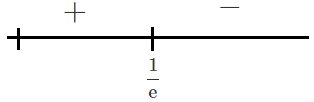
Sign scheme of f'(x) is as shown in the following figure.

From the figure, $\text{x}=\frac{1}{\text{e}}$ is the point of maxima
Hence, maximum value of y is $\Big(\frac{1}{\frac{1}{\text{e}}}\Big)^{\frac{1}{\text{e}}}=\text{e}^{\frac{1}{\text{e}}}$

Need a full question paper?

Generate a complete, print-ready paper with questions like this in minutes — across 16+ boards, with answer keys.

Start Generating Free

Similar questions

India play two matches each with West indies and Australia. In any match the probability of india getting $0,1$ and $2$ points are $0.45, 0.05$ and $0.50$ respectively. Assuming that the outcomes are indepecdent, the probability of india getting at least $7$ points is.
Let $\vec a = \hat i - \hat j,$ $\vec b = \hat i + \hat j + \hat k$ and $\vec c$ be a vector such that $\vec a \times \vec c + \vec b = 0$ and $\vec a.\vec c = 4$, then ${\left| {\vec c} \right|^2}$ is equal to
Find the area above $x$-axis, bounded by the curves $y=2^{k x}, x=0$ and $x=2$.
The area bounded by a curve, the axis of co-ordinates $\&$ the ordinate of some point of the curve is equal to the length of the corresponding arc of the curve. If the curve passes through the point $P (0, 1)$ then the equation of this curve can be
The area of the region bounded by the curve $y = x^3,$ and the lines, $y = 8,$ and $x = 0,$ is
The value of $\left[ {\frac{{\log \left( {\frac{x}{e}} \right)}}{{x - \,e}}} \right]\,\forall x\, > \,e$ is equal to (where [.] denotes greatest integer function)
Let $\text{f(x)}=\begin{vmatrix}\cos\text{x}&\text{x}&1\\2\sin\text{x}&\text{x}&2\text{x}\\\sin\text{x}&\text{x}&\text{x}\end{vmatrix},$ then $\lim_\limits{\text{x}\rightarrow0}\frac{\text{f(x)}}{\text{x}^2}$ is equal to:
Given the function $f(x) = 2x \sqrt {{x^3}\, - \,\,1}    + 5 \sqrt x  \sqrt {1\,\, - \,\,{x^4}}  + 7x^2 \sqrt {x\,\, - \,\,1} + 3x + 2$ then :
The corner points of the feasible region for a Linear Programming problem are P(0,5) Q(1, 5) R(4, 2) and S(12, 0) The minimum value of the objective function Z = 2x + 5y is at the point.
Let $\text{P}$ and $\text{Q}$ be $3\times3$ matrices with $\text{P}\neq\text{Q}.$ If $\text{P}^3=\text{Q}^3$ and $\text{P}^2\text{Q}=\text{Q}^2\text{P}$ then determinant of $(\text{P}^2+\text{Q}^2)$ is equal to: