Question
Choose the correct answer from the given four options.Let f : N → R be the function defined by $\text{f}(\text{x})=\frac{2\text{x}-1}{2}$ and g : Q → R be another function defined by g(x) = x + 2. Then $(\text{gof})\frac{3}{2}$ is:
  1. $1$
  2. $1$
  3. $\frac{7}{2}$
  4. $\text{None of these}.$

Answer

  1. $\text{none of these}.$
Solution:
We have $\text{f}(\text{x})=\frac{2\text{x}-1}{2}$ and g(x) = x + 2
$\text{gof}\Big(\frac{3}{2}\Big)=\text{g}\Big(\text{f}\Big(\frac{3}{2}\Big)\Big)$
$=\text{g}\bigg(\frac{2\times\frac{3}{2}-1}{2}\bigg)$
$=\text{g}(1)=1+2=3$

Need a full question paper?

Generate a complete, print-ready paper with questions like this in minutes — across 16+ boards, with answer keys.

Start Generating Free

Similar questions

The value of 'n', such that the differential equation $x^n \frac{d y}{d x}=y(\log y-\log x+1) ;$ (where $x, y \in R^{+}$) is homogeneous,is
If $\left|\begin{array}{ll}2 & 4 \\ 5 & 1\end{array}\right|=\left|\begin{array}{cc}2 x & 4 \\ 6 & x\end{array}\right|$, then the possible value(s) of ' $x$ ' is/are
If the vectors $a \hat{i}+\hat{j}-2 \hat{k}$ and $2 \hat{i}+3 \hat{j}-\hat{k}$ are perpendicular to each other, then the value of a will be-
If $\text{A}=\displaystyle \left[ \begin{matrix} 1 &\text{amp; 2} \\ 3&\text{amp; 4} \end{matrix} \right],$ then which of the following is not an element of A ?
  1. 0
  2. 1
  3. 2
  4. 3
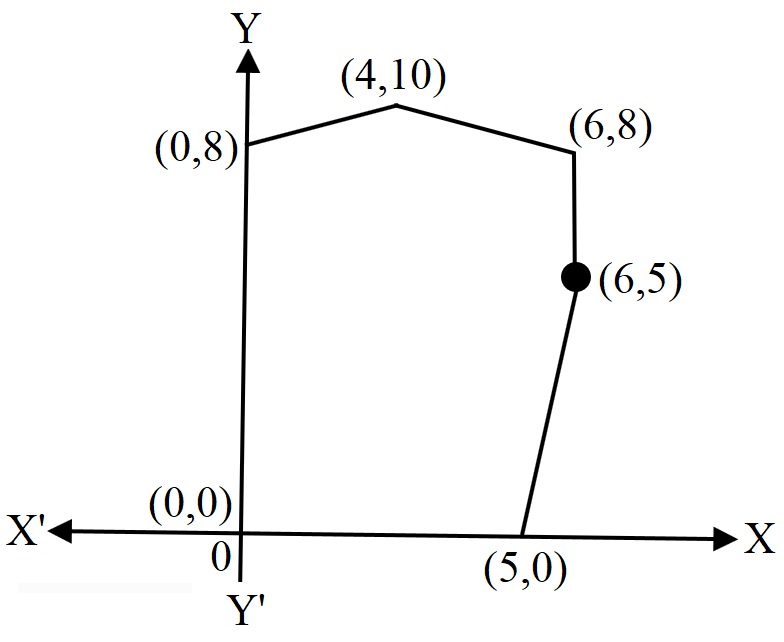
The feasible solution for a LPP is shown in the following figure. Let Z = 3x - 4y be the objective function.
Minimum of Z occurs at:
  1. (0, 0)
  2. (0, 8)
  3. (5, 0)
  4. (4, 10)
Corner points of the bounded feasible region for an LP problem are A(0, 5) B(0, 3) C(1, 0) D(6, 0). Let z = -50x + 20y be the objective function. Minimum value of z occurs at ______ center point.
  1. (0, 5)
  2. (1, 0)
  3. (6, 0)
  4. (0, 3)
If function $f$ is defined such that
$
f(x)=\left\{\begin{array}{cc}
\frac{k \cos x}{\pi-2 x}, & \text { if } x \neq \frac{\pi}{2} \\
3, & \text { if } x=\frac{\pi}{2}
\end{array}\right.
$is continuous at $x=\frac{\pi}{2}$, then value of $k$ :
If $w$ is a non $-$ real cube root of unity and $n$ is not a multiple of $3,$ then $\begin{vmatrix}1&\omega^{\text{n}}&\omega^{2\text{n}}\\\omega^{2\text{n}}&1&\omega^{\text{n}}\\\omega^{\text{n}}&\omega^{2\text{n}}&1\end{vmatrix}$ is equal to:
If points $\text{A}(60\hat{\text{i}}+3\hat{\text{j}}),\ \text{B}(40\hat{\text{i}}-8\hat{\text{j}})$ and $\text{C}(\text{a}\hat{\text{i}}+52\hat{\text{j}})$ are collinear, then a is equal to,
  1. 40
  2. -40
  3. 20
  4. -20
$\int\text{e}^{\text{x}}\Big(\frac{1-\sin\text{x}}{1-\cos\text{x}}\Big)\text{dx}=$
  1. $-\text{e}^{\text{x}}\tan\frac{\text{x}}{2}+\text{C}$
  2. $-\text{e}^{\text{x}}\cot\frac{\text{x}}{2}+\text{C}$
  3. $-\frac{1}{2}\text{e}^{\text{x}}\tan\frac{\text{x}}{2}+\text{C}$
  4. $-\frac{1}{2}\text{e}^{\text{x}}\cot\frac{\text{x}}{2}+\text{C}$