MCQ
Choose the correct answer. The standard deviation of some temperature data in $^\circ C$ is $5.$ If the data were converted into $^\circ F,$ the variance would be:
  • $81$
  • B
    $57$
  • C
    $27$
  • D
    $36$

Answer

Correct option: A.
$81$
Given that $\sigma_\text{c}=5$
We know that $\text{C}=\frac{5}{9}(\text{F}-32)$
$\Rightarrow\text{F}=\frac{9\text{C}}{5}+32$
$\therefore\ \sigma_\text{F}=\frac{9}{5}\sigma_\text{c}=\frac{9}{5}\times5=9$
$\therefore\ \sigma^2_{\text{F}}=(9)^2=81$

Need a full question paper?

Generate a complete, print-ready paper with questions like this in minutes — across 16+ boards, with answer keys.

Start Generating Free

Similar questions

If the centre of a circle which passing through the points of intersection of the circles ${x^2} + {y^2} - 6x + 2y + 4 = 0$and ${x^2} + {y^2} + 2x - 4y - 6 = 0$ is on the line $y = x$, then the equation of the circle is
Let $\mathrm{a}_{1}, \mathrm{a}_{2}, \mathrm{a}_{3}, \ldots$ be an $A.P.$ If $\frac{a_{1}+a_{2}+\ldots+a_{10}}{a_{1}+a_{2}+\ldots+a_{p}}=\frac{100}{p^{2}}, p \neq 10$, then $\frac{a_{11}}{a_{10}}$ is equal to :
If $z$ is a complex number such that ${z^2} = {(\bar z)^2},$ then
The coordinates of any point, which lies in $yz$ plane, are:
If $a, b, c$ are in $G.P.$ and $\text{a}^{\frac{1}{\text{x}}}=\text{b}^{\frac{1}{\text{y}}}=\text{c}^{\frac{1}{\text{z}}},$ then $xyz$ are in:
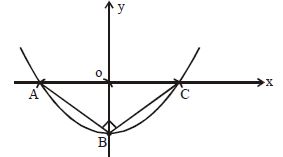
If graph of $y = ax^2 + bx + c$ as follows

$\Delta ABC$ is right angled osceles triangle with hypotenuse $AC = 4\sqrt 2\ units$ then minimum value of $ax^2 + bx + c$ is
Let $P(4, -4)$ and $Q(9, 6)$ be two points on the parabola, $y^2 = 4x$ and let $X$ be any point on the arc $POQ$ of this parabola, where $O$ is the vertex of this parabola, such that the area of $\Delta PXQ$ is maximum. Then this maximum Area (in sq. units) is
If the $6^{th}$ term in the expansion of the binomial ${\left[ {\sqrt {{2^{\log (10 - {3^x})}}} + \sqrt[5]{{{2^{(x - 2)\log 3}}}}} \right]^m}$ is equal to $21$ and it is known that the binomial coefficients of the $2^{nd}$, $3^{rd}$ and $4^{th}$ terms in the expansion represent respectively the first, third and fifth terms of an $A.P$. (the symbol log stands for logarithm to the base $10$), then $x = $
In a survey of $220$ students of a higher secondary school, it was found that at least $125$ and at most $130$ students studied Mathematics; at least $85$ and at most $95$ studied Physics; at least $75$ and at most $90$ studied Chemistry; $30$ studied both Physics and Chemistry; $50$ studied both Chemistry and Mathematics; $40$ studied both Mathematics and Physics and $10$ studied none of these subjects. Let $\mathrm{m}$ and $\mathrm{n}$ respectively be the least and the most number of students who studied all the three subjects. Then $\mathrm{m}+\mathrm{n}$ is equal to .............................
In a throw of three dice, the probability that at least one die shows up $1$, is