MCQ
Choose the correct answers from the given four options:
If $\text{f(x)}=\text{x}^2\sin\frac{1}{\text{x}},$ where $\text{x}\neq0,$ then the value of the function f at x = 0, so that the function is continuous at x = 0, is:
  • 0
  • B
    -1
  • C
    1
  • D
    None of these

Answer

Correct option: A.
0
The value of the function f at x = 0, so that it is continuous at x = 0 is 0.

Need a full question paper?

Generate a complete, print-ready paper with questions like this in minutes — across 16+ boards, with answer keys.

Start Generating Free

Similar questions

If x, y, z are non-zero real numbers, then the inverse, then the inverse of the matrix $\begin{bmatrix}\text{x} & 0 & 0\\ 0 & \text{y} & 0 \\ 0 & 0 & \text{z}\end{bmatrix}$, is:
Choose the correct answer from the given four option. Integrating factor of $\frac{\text{xd}\text{y}}{\text{d}\text{x}}-\text{y}=\text{x}^4-3\text{x}$ is :
The existance of the unique solution of the system of equations$2x + y + z = \beta $ , $10x - y + \alpha z = 10$ and $4x+ 3y-z =6$ depends on
If the function $y = e^{4x} + 2e^{-x}$ is a solution of the differential equation $\frac{{\frac{{{d^3}y}}{{d{x^3}}} - 13\frac{{dy}}{{dx}}}}{y} = K$ then the value of $K$ is
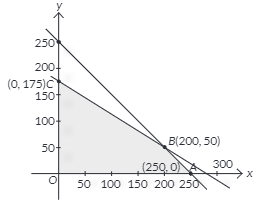
The corner points of the bounded feasible region of an LPP are $O(0,0), A(250,0), B(200,50)$ and $C(0,175)$. If the maximum value of the objective function $Z=2 a x+$ by occurs at the points $A(250,0)$ and $B(200,50)$, then the relation between $a$ and $b$ is:
Image
The binary operation $^*$ is defined by $a ^* b = a^2 + b^2 + ab + 1,$ then $(2 ^* 3) ^* 2$ is equal to:
If $ \text{A}+\displaystyle \begin{vmatrix} 4 &\text{amp; } 2 \\ 1 &\text{amp; } 3 \end{vmatrix}=\displaystyle \begin{vmatrix} 6 &\text{amp; } 9 \\ 1 &\text{amp; } 4\end{vmatrix} $ then $\text{A}=$
Let $\vec{a}, \vec{b}, \vec{c}$ be unit vectors such that $\vec{a}+\vec{b}+\vec{c}=\overrightarrow{0}$. Which one of the following is correct?
On the set $Q^+$ of all positive rational numbers a binary operation $*$ is defined by $\text{a}^*\text{b}=\frac{\text{ab}}2\forall\text{ a, b}\in \text{Q}^+$. The inverse of $8$ is:
The length of the perpendicular from the point $(2, -1, 4)$ on the straight line, $\frac{{x + 3}}{{10}} = \frac{{y - 2}}{{ - 7}} = \frac{z}{1}$ is