Question
Choose the correct option about light.

Answer

  1. Light does not require a material medium to propagate.
Explanation:
Light does not need medium to travel. Its an electromagnetic wave. All electromagnetic waves travel independent of medium.

Need a full question paper?

Generate a complete, print-ready paper with questions like this in minutes — across 16+ boards, with answer keys.
Start Generating Free

Similar questions

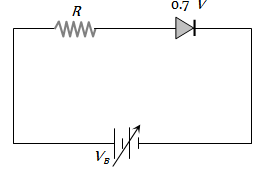
The junction diode in the following circuit requires a minimum current of $1\ mA$ to be above the knee point $(0.7 V)$ of its $I-V$ characteristic curve. The voltage across the diode is independent of current above the knee point. If $V_B = 5V,$ then the maximum value of $R$ so that the voltage is above the knee point, will be
An energy of 24.6 eV is required to remove one of the electrons from a neutral helium atom. The energy (in eV) required to remove both the electrons from a neutral helium atom is(a) 79.0 (b) 51.8(c) 49.2   (d) 38.2
       
Assertion  :   In photoelectric effect, on increasing the intensity of light, both the number of electrons emitted and kinetic energy of each of them get increased but photoelectric current remains unchanged.
Reason     : The photoelectric current depends only on wavelength of light.(a) If both assertion and reason are true and the reason is the correct explanation of the assertion.(b) If both assertion and reason are true but reason is not the correct explanation of the assertion.(b) If both assertion and reason are true but reason is not the correct explanation of the assertion.(d) If the assertion and reason both are false.


The internal resistance of a primary cell is 4 ohm. It generates a current of 0.2 amp in an external resistance of 21 ohm. The rate at which chemical energy is consumed in providing the current is(a) 0.42 J/s(b) 0.84 J/s(c) 5 J/s   (d) 1 J/s
       
A very thin film in reflected white light appears:
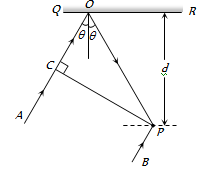
In the adjacent diagram, $CP$ represents a wavefront and $AO\ \&\ BP,$ the corresponding two rays. Find the condition on $q$  for constructive interference at $P$ between the ray $BP$ and reflected ray $OP$
The potential at a distance $R / 2$ from the centre of a conducting sphere of radius $R$ will be
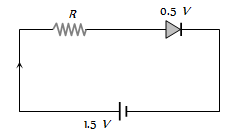
The diode used in the circuit shown in the figure has a constant voltage drop of $0.5 V$ at all currents and a maximum power rating of $100$ milliwatts. What should be the value of the resistor $R,$ connected in series with the diode for obtaining maximum current
The perpendicular distance between the original path of the incident ray and the convergent ray of light coming out of a glass slab is called:
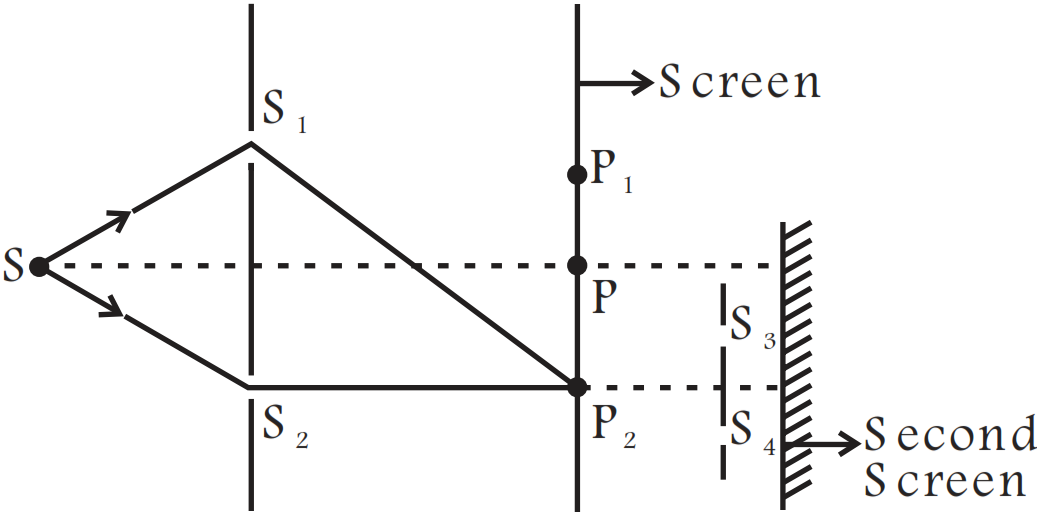
Figure shows a standard two slit arrangement with slits $S_1, S_2. P_1, P_2$ are the two minima points on either side of $P \ ($Fig$)$. At $P_2$ on the screen, there is a hole and behind $P_2$ is a second $2- $ slit arrangement with slits $S_3, S_4$ and a second screen behind them.