MCQ
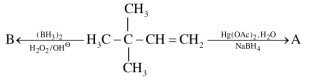
Choose the correct option for the following reactions.
  • A
    '$A$' and '$B$' are both Markovnikov addition products.
  • '$A$' is Markovnikov product and '$B$'is anti-Markovnikov product.
  • C
    '$A$' and '$B$' are both anti-Markovnikov products.
  • D
    '$B$' is Markovnikov and '$A$' is anti-Markovnikov product.
Answer

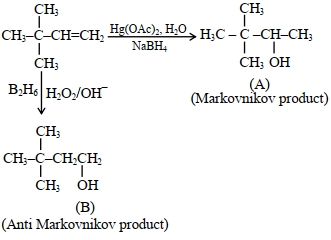
Correct option: B.
'$A$' is Markovnikov product and '$B$'is anti-Markovnikov product.
b

Need a full question paper?

Generate a complete, print-ready paper with questions like this in minutes — across 16+ boards, with answer keys.

Start Generating Free

Similar questions

The $IUPAC$ name for $K_2[Cr(CN)_2O_2(O_2)NH_3]$ is
Given below are two statements: one is labelled as Assertion $(A)$ : and the other is labelled as Reason $(R)$. Assertion $(A)$ : Both rhombic and monoclinic sulphur exist as $S_5$ while oxygen exists as $O_2$.

Reason $(R)$ : Oxygen forms $\mathrm{p} \pi-\mathrm{p} \pi$ multiple bonds with itself and other elements having small size and high electronegativity like $\mathrm{C}, \mathrm{N}$, which is not possible for sulphur.

In the light of the above statements, choose the most appropriate answer from the options given below :

The $H - O - H$ bond angles in $H_3O^+$ are approximately $107^o$. The  orbitals used by oxygen in these bonds are best described as
The reaction ;
$\frac{1}{2} H _{2(g)}+ AgCl _{( s )} \rightarrow H _{( aq )}^{+}+ Cl _{( aq )}^{-}+ Ag _{( s )}$
occurs in which of the following galvanic cell :
Among $Ni(CO)_4, [Ni(CN)_4]^{2-}$ and $[Ni(Cl)_4]^{2-}$
$A + 2B \to C + D$. If $ - \frac{{d[A]}}{{dt}} = 5 \times {10^{ - 4}}\,mol\,{l^{ - 1}}{s^{ - 1}}$1, then $ - \frac{{d[B]}}{{dt}}$ is
A solution containing $62\,g$ ethylene glycol in $250\,g$ water is cooled to $-10\,^oC. $ If $K_f$ for water is $1.86\,K\,kg\,mol^{-1},$ the amount of water(in $g$ ) separated as ice is
Given : $I$ and $II$ are
Consider the following complexes.

$\left[\mathrm{CoCl}\left(\mathrm{NH}_3\right)_5\right]^{2+}, \quad\left[\mathrm{Co}(\mathrm{CN})_6\right]^{3-} \text {, }$

$(A)$                                        $(B)$

$\left[\mathrm{Co}\left(\mathrm{NH}_3\right)_5\left(\mathrm{H}_2 \mathrm{O}\right)\right]^{3+}, \quad\left[\mathrm{Cu}\left(\mathrm{H}_2 \mathrm{O}\right)_4\right]^{2+}$

$(C)$                                       $(D)$

The correct order of $A$, $B$, $C$ and $D$ in terms of wavenumber of light absorbed is :

$B{F_3}$ and $N{F_3}$ both molecules are covalent, but $B{F_3}$ is non-polar and $N{F_3}$ is polar. Its reason is