MCQ
Choose the correct statement
- ✓Amino polarization is more pronounced by highly charged cation
- BSmall cation has minimum capacity to polarise an anion.
- CSmall anion has maximum polarizability
- DNone of these
Generate a complete, print-ready paper with questions like this in minutes — across 16+ boards, with answer keys.
$Cu ( s )+ Sn ^{2+}( aq ) \rightarrow Cu ^{2+}( aq )+ Sn ( s )$
$\left( E _{ Sn ^{2+} \mid Sn }^{0}=-0.16\, V , E _{ Cu ^{2+} \mid Cu }^{0}=0.34\, V \right.$ Take $F=96500\, C\, mol ^{-1}$ )
| List$-I$ | List$-II$ |
| $A$ $16\,g \text { of } CH _{4( g )}$ | $I$ Weighs $28\,g$ |
| $B$ $1\,g \text { of } H _{2( g )}$ | $II$ $60.2 \times 10^{23}$ electrons |
| $C$ $1\,mole \text { of } N _{2( g )}$ | $III$ Weighs $32\,g$ |
| $D$ $0.5\,mol$ of $SO _{2( g )}$ | $IV$ Occupies $11.4\,L$ volume at STP |
Choose the correct answer from the options given below:
$\begin{array}{*{20}{c}}
{Cl\,\,\,\,} \\
{|\,\,\,\,\,\,\,\,} \\
{C{H_3} - CH - COOH}
\end{array}\mathop {\xrightarrow{{(i)\,N{H_3}}}}\limits_{1\,mole\,\,(ii)\,{H_2}O} [X]$
Product $[X]$ will be :
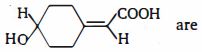
$2Na(s) + 2HCl(g)\,\, \to \,\,2NaCl(s) + {H_2}(g),$$\Delta H = - 152\,kcal$ For the reaction $Na(s) + \frac{1}{2}C{l_2}(g)\,\, \to \,\,NaCl(s),\,\Delta H = $ .....$kcal$
$\begin{array}{*{20}{c}} {{H_3}C - C{H_2} - CH - Et} \\ {\,\,\,\,\,\,\,\,\,\,\,\,\,\,\,\,\,\,\,\,\,\,\,\,\,\,\,\,\,\,\,\,\,\,\,|\,\,\,\,\,\,\,\,\,\,\,\,\,\,\,\,\,\,\,} \\ {\,\,\,\,\,\,\,\,\,\,\,\,\,\,\,\,\,\,\,\,\,\,\,\,\,\,\,\,\,\,\,\,\,\,\,\,C{H_3}\,\,\,\,\,\,\,\,\,\,\,\,\,\,\,} \end{array}$ about $C_2-C_3$ is (figure) 