MCQ
Choose the correct statement.
  • A
    A sphere can do pure rolling on smooth horizontal surface
  • B
    A sphere can't do pure rolling on a fixed smooth wedge
  • C
    Rolling friction can act parallel or antiparallel to the direction of motion
  • All of these

Answer

Correct option: D.
All of these
d
(d)

Need a full question paper?

Generate a complete, print-ready paper with questions like this in minutes — across 16+ boards, with answer keys.
Start Generating Free

Similar questions

A tuning fork $A$ produces $4$ beats/sec with another tuning fork $B$ of frequency $320 Hz$. On filing the fork $A$, $4$ beats/sec are again heard. The frequency of fork $A$, after filing is ....$Hz$
Two planets have the same average density but their radii are ${R_1}$ and ${R_2}$. If acceleration due to gravity on these planets be ${g_1}$ and ${g_2}$ respectively, then
Two bodies are projected with the same velocity. If one is projected at an angle of ${30^o}$ and the other at an angle of ${60^o}$ to the horizontal, the ratio of the maximum heights reached is
An object is moving in a circle of radius $100 \,m$ with a constant speed of $31.4 \,m/s$. What is its average speed for one complete revolution ......... $m/s$
A rod of length $L$ has non-uniform linear mass density given by $\rho(\mathrm{x})=\mathrm{a}+\mathrm{b}\left(\frac{\mathrm{x}}{\mathrm{L}}\right)^{2},$ where $a$ and $\mathrm{b}$ are constants and $0 \leq \mathrm{x} \leq \mathrm{L}$. The value of $\mathrm{x}$ for the centre of mass of the rod is at
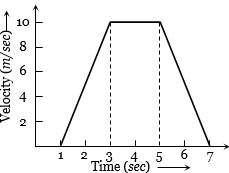
For the velocity-time graph shown in figure below the distance covered by the body in last two seconds of its motion is what fraction of the total distance covered by it in all the seven seconds
If velocity $v$, acceleration $A$ and force $F$ are chosen as fundamental quantities, then the dimensional formula of angular momentum in terms of $v,\,A$ and $F$ would be
Length of a string tied to two rigid supports is $40 cm$. Maximum length (wavelength in $cm$) of a stationary wave produced on it is ... $cm$
A vessel contains $1$ mole of ${O_2}$ gas (molar mass $32)$ at a temperature $T.$ The pressure of the gas is $P. $ An identical vessel containing one mole of $He$ gas (molar mass $4)$ at temperature $2T$ has a pressure of
Equations ${y_1} = A\sin \omega t$ and ${y_2} = \frac{A}{2}\sin \omega t + \frac{A}{2}\cos \omega t$ represent $S.H.M.$ The ratio of the amplitudes of the two motions is