Question
Choose the incorrect statement from the following: When two identical capacitors are charged individually to different potentials and connected parallel to each other after disconnecting them from the source(a) Net charge equals the sum of initial charges(b) The net energy stored in the two capacitors is less than the sum of the initial individual energies(c) The net potential difference across them is different from the sum of the individual initial potential difference(d) The net potential difference across them equals the sum of the individual initial potential differences


Answer

(d) The net potential difference across them equals the sum of the individual initial potential differences

Need a full question paper?

Generate a complete, print-ready paper with questions like this in minutes — across 16+ boards, with answer keys.

Start Generating Free

Similar questions

An electron jumps from $5^{\text {th }}$ orbit to $4^{\text {th }}$ orbit of hydrogen atom. Taking the Rydberg constant as $10^7$ per metre. What will be the frequency of radiation emitted
In a single slit diffraction experiment first minimum for red light (660 nm) coincides with first maximum of some other wavelength l'. The value of l' is (a) 4400 Å(b) 6600 Å(c) 2000 Å(d) 3500 Å
       
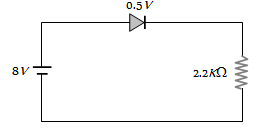
In the circuit, if the forward voltage drop for the diode is $0.5V,$ the current will be
Which radiation in sunlight, causes heating effect(a) Ultraviolet (b) Infrared(c) Visible light(d) All of these
       
In diode, when there is saturation current, the plate resistance $e\left({ }^{r_p}\right)$  is
For a transistor, the current amplification factor is 0.8. The transistor is connected in common emitter configuration. The change in the collector current when the base current changes by 6 mA is (a) 6 mA(b) 4.8 mA(c) 24 mA(d) 8 mA
       
The capacitance of a capacitor is C. It is charged at a potential difference V. If now it is related to resistance, the amount of energy dilapidation will be:
A sphere can roll on a surface inclined at an angle $\theta$ if the friction coefficient is more than $\frac{2}{7}\text{g}\tan \theta.$ Suppose the friction coefficient is $\frac{1}{7}\text{g}\tan \theta.$ If a sphere is released from rest on the incline:
  1. It will stay at rest.
  2. It will make pure translational motion.
  3. It will translate and rotate about the centre.
  4. The angular momentum of the sphere about its centre will remain constant.
Which of the following is an example of a molecule whose centre of mass of positive and negative charges does not coincide each other?
A wire 2 m long is moving with velocity of $1 m / s$ perpendicular to a magnetic field of $0.5 Wb / m ^2$. The magnitude of induced cmf in it is :