MCQ
Choose the wrong option.
  • A
    Inertial mass is a measure of difficulty of accelerating a body by an external force whereas the gravitational mass is relevant in determining the gravitational force on it by an external mass.
  • B
    That the gravitational mass and inertial mass are equal is an experimental result.
  • C
    That the acceleration due to gravity on earth is the same for all bodies is due to the equality of gravitational mass and inertial mass.
  • D
    Gravitational mass of a particle like proton can depend on the presence of neighouring heavy objects but the inertial mass cannot.
Answer

  1. Gravitational mass of a particle like proton can depend on the presence of neighouring heavy objects but the inertial mass cannot.

Explanation:

Key concept:

  1. Inertial mass: It is the mass of the material body, which measures its inertia.

  2. Gravitational Mass: It is the mass of the material body, which determines the gravitational pull acting upon it. According to the principle of equivalence, Gravitational mass of proton is equivalent to its inertial mass and is independent of presence of neighboring heavy objects.

  3. Important point: Comparison between inertial and gravitational mass:

  • Both are measured in the same units.
  • Both are scalars.
  • Both do not depend on the shape and state of the body.
  • Inertial mass is measured by applying Newton’s second law of motion whereas gravitational mass is measured by applying Newton’s law of gravitation.
  • Spring balance measures gravitational mass and inertial balance measure inertial mass.

Need a full question paper?

Generate a complete, print-ready paper with questions like this in minutes — across 16+ boards, with answer keys.

Start Generating Free

Similar questions

A wire of length $2\,L$ is made by joining two wires $A$ and $B$ of same lengths but different radii $r$ and $2r$ and made of the same material. It is vibrating at a frequency such that the joint of the two wires forms a node. If the number of antinodes in wire $A$ is $p$ and that in $B$ is $q$ then the ratio $p : q$ is
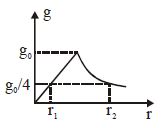
Figure shows variation of acceleration due to gravity with distance from centre of a  uniform spherical planet, Radius of planet is $R$. What is $r_2 -r_1.$
The unit of absolute permittivity is
The density of a non-uniform rod of length 1m is given by $\rho(\text{x})=\alpha(1+\text{b}\text{x}^2)$ where a and b are constants and $0\leq\text{x}\leq1$ The centre of mass of the rod will be at:

  1. $\frac{3(2+\text{b})}{4(3+\text{b})}$

  2. $\frac{4(2+\text{b})}{3(3+\text{b})}$

  3. $\frac{3(3+\text{b})}{4(2+\text{b})}$

  4. $\frac{4(3+\text{b})}{3(2+\text{b})}$

A gas is filled in a cylinder, its temperature is increased by $20\%$ on Kelvin scale and volume is reduced by $10\%.$ How much percentage of the gas will leak out ........ $\%$
Young's modulus of a wire depends on:
A spherical body of mass $2\,kg$ starting from rest acquires a kinetic energy of $10000\,J$ at the end of $5^{\text {th }}$ second. The force acted on the body is $.....N$
Which of the following has the maximum momentum?
A parachutist of weight $‘w’$ strikes the ground with his legs fixed and comes to rest with an upward acceleration of magnitude $3 \,g$. Force exerted on him by ground during landing is
A $140\, g$ ball, in horizontal flight with a speed $v_1$ of $39.0\, m/s$, is struck by a bat. After leaving the bat, the ball travel in the opposite direction with speed $v_2 = 39.0\, m/s$. If the impact time $\Delta t$ for the ball-bat collision is $1.20\, ms$, what average net force acts on the ball ......... $N$