Question
Classification of solid based on conductivity

Answer

→ Materials are classified into conductors, insulators and semiconductors depending on the magnitude of their conductivity.
→ Metals and their alloys have very high conductivity and are known as conductors.
→ Certain non-metals like carbon-black, graphite and some organic polymers* are also possess electronically conductivity.
→ Substances like glass, ceramics, etc., having very low conductivity are known as insulators.
→ Substance like silicon, doped silicon and gallium arsenide having conductivity between conductors and insulators are called semiconductors and are important electronic materials.
→ Certain material called superconductors exhibit zero resistivity or infinite conductivity.
→ Earlier, only metals and their alloys at very low temperatures (0 to 15 K) were known to behave as superconductors, but now days a number of ceramic materials and mixed oxides are also known to show superconductivity at temperatures as high as 150 K.
→ The values of Conductivity of some Selected Materials at 298.15 K are given below.
MaterialConductivity/S$m ^{-1}$MaterialConductivity/S$m ^{-1}$
Conductors Aqueous Solution
Sodium$2.1 \times 10^3$Pure water$3.5 \times 10^{-5}$
Copper$5.9 \times 10^3$0.1 M HCl3.91
Silver$6.2 \times 10^3$0.01 M KCI0.14
Gold$4.5 \times 10^3$0.01M NaCl0.12
Iron$1.0 \times 10^3$0.1 M HAc0.047
Graphite$1.2 \times 10$0.01M HAc0.016
Insulators Semiconductors
Glass$1.0 \times 10^{-16}$CuO$1 \times 10^{-7}$
Teflon$1.0 \times 10^{-18}$Si$1.5 \times 10^{-2}$

Need a full question paper?

Generate a complete, print-ready paper with questions like this in minutes — across 16+ boards, with answer keys.
Start Generating Free

Similar questions

Write the Nernst equation and emf of the following cells at 298 K : $\mathrm{Fe}(\mathrm{s})\left|\mathrm{Fe}^{2+}(0.001 \mathrm{M})\right|\left|\mathrm{H}^{+}(1 \mathrm{M})\right| \mathrm{H}_2(\mathrm{~g})(1$ bar $) \mid \mathrm{Pt}(\mathrm{s})$
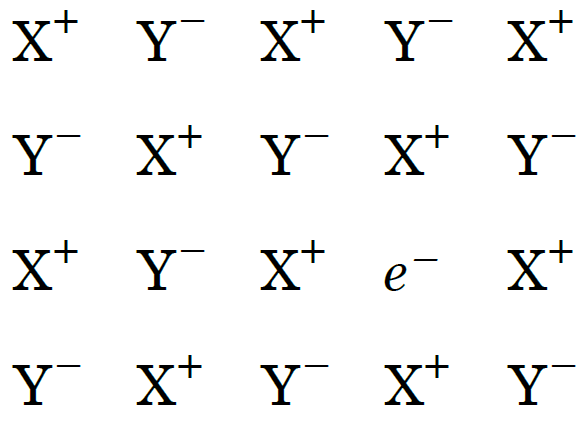
Examine the given defective crystal:
Answer the following questions:
  1. Is the above defect stoichiometric or non-stoichiometric?
  2. write the term used for the electron occupied site.
  3. Give an example of the compound which shows this type of defect.
  1. What type of semiconductor is obtained when silicon is doped with boron?
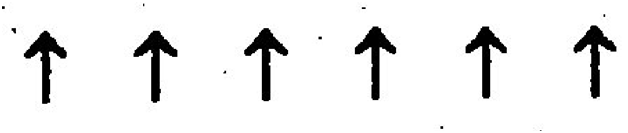
  2. What type of magnetism is shown in the following alignment of magnetic moments?
  1. What type of point defect is produced when $AgCl$ is doped with $CdCl_2?$
Amino acids may be acidic, alkaline or neutral. How does this happen? What are essential and non-essential amino acids? Name one of each type.

Complete the following giving the structures of major organic products.
Describe the following$:$
$i.$ Acetylation
$ii.$ Cannizzaro reaction
$iii.$ Cross aldol condensation
$iv.$ Decarboxylation
Explain what is observed when:
  1. KCl, an electrolyte, is added to hydrated ferric oxide sol,
  2. An electric current is passed through a colloidal solution,
  3. A beam of light is passed through a colloidal solution.
Match the properties given in Column I with the metals given in Column II.
 
Column I (Property)
 
Column II (Metal)
(i)
An element which can show +8 oxidation state
(a)
Mn
(ii)
3d block element that can show upto +7 oxidation state
(b)
Cr
(iii)
3d block element with highest melting point
(c)
Os
   
(d)
Fe
The molar conductivity of $0.025\ mol\ L^{–1}$ methanoic acid is $46.1\ S\ cm^2\ mol^{–1}.$ Calculate its degree of dissociation and dissociation constant. Given $\lambda ^0 (H^+) = 349.6\ S\ cm^2\ mol^{–1}$ and $\lambda^0 (HCOO^–) = 54.6\ S\ cm^2\ mol^{-1}.$
Determine the osmotic pressure of a solution prepared by dissolving $25$ mg of $K_2SO_4$ in $2$ litre of water at $25^\circ C$, assuming that it is completely dissociated.
