Question
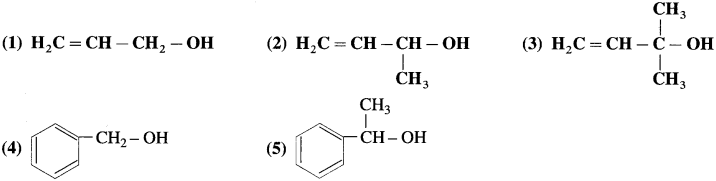
Classify the following alcohols as l0/2°/3° and allylic/benzylic

Image

Answer

(1) Ally lie alcohol (primary)
(2) Allylic alcohol (secondary)
(3) Allylic alcohol (tertiary)
(4) Benzylic alcohol (primary)
(5) Benzylic alcohol (secondary)

Need a full question paper?

Generate a complete, print-ready paper with questions like this in minutes — across 16+ boards, with answer keys.
Start Generating Free

Similar questions

Ammonia and oxygen react at high temperature as:
$
4 NH _{3( g )}+5 O _{2( g )} \longrightarrow 4 NO _{( g )}+6 H _2 O _{( g )}
$
In an experiment, rate of formation of $NO _{( g )}$ is $3.6 \times 10^{-3} mol L ^{-1} \cdot s ^{-1}$
Calculate: (a) Rate of disappearance of ammonia. (b) Rate of formation of water.
The half-life of a first order reaction is $900 min$ at $820 K$. Estimate its half-life at $720 K$ if the energy of activation of the reaction is $250 kJ mol ^{-1}\left(1.464 \times 10^5 mm \right)$.
What are the characteristics of ideal solutions ?
Why is $H _2 S$ a liquid and $H _2 S$ a gas?
###
Water is a liquid and other hydrides of the group, are gases. Explain.
Calculate $C - Cl$ bond enthaply from following reaction:
$CH _3 Cl _{( g )}+ Cl _{2( g )} \longrightarrow CH _2 Cl _{2( g )}+ HCl _{( g )} ; \Delta H ^0=-104 kJ$ if $C - H , Cl - Cl$ and $H - Cl$ bond enthalpies are $414,243$ and $431 kJ - mol ^{-1}$ respectively.
Explain bond enthalpy in polyatomic molecules.
Chymotrypsin is a digestive enzyme that hydrolyzes those amide bonds for which the carbonyl group comes from phenylalanine, tyrosine or tryptophan. Write the symbols of the amino acids and peptides smaller than pentapeptide formed by hydrolysis of the following hexapeptide with chymotrypsin. Gly-Tyr-Gly-Ala-Phe-Val
The values of first ionisation enthalpy of $S$ and $Cl$ are $1000$ and $1256 kJ mol^{-1}$​​​​​​​, respectively. Explain the observed trend.
Write reactions involved in the formation of Teflon 
For the reaction,
$CH _3 Br ( aq )+ OH -( aq ) \rightarrow CH _3 OH ^{\ominus}( aq )+ Br ^{\ominus}( aq )$, rate law is rate $= k \left[ CH _3 Br \right]\left[ OH ^{\ominus}\right]$
a. How does reaction rate changes if $\left[ OH ^{\ominus}\right]$ is decreased by a factor of $5$ ?
b. What is change in rate if concentrations of both reactants are doubled?