Question
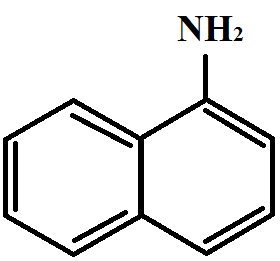
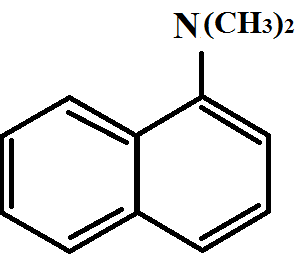
✓
Answer
- 1°
- -3°
- 1°
- 2°
Need a full question paper?
Generate a complete, print-ready paper with questions like this in minutes — across 16+ boards, with answer keys.
Explore more
Similar questions
Analyse the given graph, drawn between concentration of reactant vs. time.
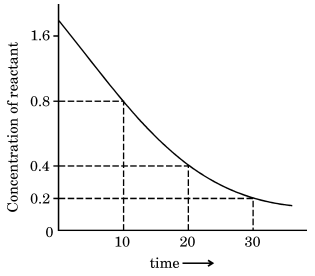
(a) Predict the order of reaction.
(b) Theoretically, can the concentration of the reactant reduce to zero after infinite time? Explain.
(a) Predict the order of reaction.
(b) Theoretically, can the concentration of the reactant reduce to zero after infinite time? Explain.
In a reaction between A and B, the initial rate of reaction (r0) was measured for different initial concentrations of A and B as given below:
What is the order of the reaction with respect to A and B?
| A/mol L-1 | 0.20 | 0.20 | 0.40 |
| B/mol L-1 | 0.30 | 0.10 | 0.05 |
| r0/mol L-1 s-1 | 5.07 × 10⁻⁵ | 5.07 × 10⁻⁵ | 1.43 × 10⁻⁴ |
What are polysaccharides? Give one example.
Write down chemical equations to prepare following substances from 1-Chloropropane.
Answer the following:
(a) a. Write the mathematical relation between rate constant and half-life of a first order reaction.
b. What is collision frequency?
(b) If the rate equation is given below:
Rate = k[A]2[B]
then what will be the unit of its rate and rate constant?
(a) a. Write the mathematical relation between rate constant and half-life of a first order reaction.
b. What is collision frequency?
(b) If the rate equation is given below:
Rate = k[A]2[B]
then what will be the unit of its rate and rate constant?
What are amine compounds? Explain with an example ?
What is meant by ‘disproportionation’? Give two examples of disproportionation reaction in aqueous solution.
State Raoult's law for the solution containing volatile components. What is the similarity between Raoult's law and Henry's law?
Which alkyl halide from the following pairs would you expect to react more rapidly by an SN2 mechanism? Explain your answer.
$\text{CH}_3\text{CH}_2\text{CH}_2\text{CH}_2\text{Br}\ \text{or}\ \text{CH}_3\text{CH}_2\text{CH}\text{CH}_3\\\ \ \ \ \ \ \ \ \ \ \ \ \ \ \ \ \ \ \ \ \ \ \ \ \ \ \ \ \ \ \ \ \ \ \ \ \ \ \ \ \ \ \ \ \ \ \ \ \ \ \ \ \ \ \ \ \mid\\\ \ \ \ \ \ \ \ \ \ \ \ \ \ \ \ \ \ \ \ \ \ \ \ \ \ \ \ \ \ \ \ \ \ \ \ \ \ \ \ \ \ \ \ \ \ \ \ \ \ \ \ \ \ \ \text{Br}$
→$\text{CH}_3\text{CH}_2\text{CH}_2\text{CH}_2\text{Br}\ \text{or}\ \text{CH}_3\text{CH}_2\text{CH}\text{CH}_3\\\ \ \ \ \ \ \ \ \ \ \ \ \ \ \ \ \ \ \ \ \ \ \ \ \ \ \ \ \ \ \ \ \ \ \ \ \ \ \ \ \ \ \ \ \ \ \ \ \ \ \ \ \ \ \ \ \mid\\\ \ \ \ \ \ \ \ \ \ \ \ \ \ \ \ \ \ \ \ \ \ \ \ \ \ \ \ \ \ \ \ \ \ \ \ \ \ \ \ \ \ \ \ \ \ \ \ \ \ \ \ \ \ \ \text{Br}$
What are anomers? Give one example.