Question
Clear the difference between interference and diffraction.

Answer

S.No.InterferenceDiffraction
1.Interference occurs due to the superposition of two or more in phase waves of the same frequency.Diffractioon occurs due to superposition of secondary wavelets emitted from the same wave front.
2.In the interference pattern all illuminated fringes have the same intensity.In the diffraction pattern, the intensity of the central illuminated fringe is maximum and the intensity of other illuminated fringes is in decreasing order.
3.In the interference pattern of waves of equal amplitude the intensity of the dark fringe is zero.The dark fringes in the diffraction pattern are not to zero intensity
4.The fringes in an interference pattern are generally of equal width.The fringes in a diffraction pattern are always of   unequal width.
5.There is a good contrast between bright and dark particles.There is poor contrast in bright or fork fringes.

Need a full question paper?

Generate a complete, print-ready paper with questions like this in minutes — across 16+ boards, with answer keys.

Start Generating Free

Similar questions

A rectangular loop of sides 20cm and 10cm carries a current of 5.0A. A uniform magnetic field of magnitude 0.20T exists parallel to the longer side of the loop.
  1. What is the force acting on the loop?
  2. What is the torque acting on the loop?
A particle of mass m and charge q is released from the origin in a region in which the electric field and magnetic field are given by
$\overrightarrow{\text{B}}=-\text{B}_0\overrightarrow{\text{j}}$ and $\overrightarrow{\text{E}}=\text{E}_0\overrightarrow{\text{k}}.$ Find the speed of the particle as a function of its z-coordinate.
A system has two charges qA = 2.5 × 10⁻⁷ C and qB = –2.5 × 10⁻⁷ C located at points A: (0, 0, –15 cm) and B: (0, 0, +15 cm), respectively. What are the total charge and electric dipole moment of the system?
Consider a 20W bulb emitting light of wavelength $5000\mathring{\text{A}}$ and shining on a metal surface kept at a distance 2m. Assume that the metal surface has work function of 2eV and that each atom on the metal surface can be treated as a circular disk of radius $1.5\mathring{\text{A}}$.
  1. Estimate no. of photons emitted by the bulb per second. [Assume no other losses]
  2. Will there be photoelectric emission?
  3. How much time would be required by the atomc disk to receive energy equal to work function (2eV)?
  4. How many photons would atomic disk receive within time duration calculated in (iii) above?
  5. Can you explain how photoelectric effect was observed instantaneously?
Hint: Time calculated in part (iii) is from classical consideration and you may further take the target of surface area say 1cm2 and estimate what would happen?
The equation of a wave travelling on a string stretched along the X-axis is given by-

$\text{y}=\text{A}\text{e}^{-\Big(\frac{\text{x}}{\text{a}}+\frac{\text{t}}{\text{T}}\Big)^2}.$
  1. Write the dimensions of A, a and T.
  2. Find the wave speed.
  3. In which direction is the wave. travelling?
  4. Where is the maximum of the pulse located at t = T? at t = 2T?
  1. Explain, giving reasons, the basic difference in converting a galvanometer into (i) a voltmeter and (ii) an ammeter.
  2. Two long straight parallel conductors carrying steady currents I1 and I2 are separated by a distance 'd'. Explain briefly, with the help of a suitable diagram, how the magnetic field due to one conductor acts on the other. Hence deduce the expression for the force acting between the two conductors. Mention the nature of this force.
At what angle should a ray of light be incident on the face of a prism of refracting angle 60° so that it just suffers total internal reflection at the other face? The refractive index of the material of the prism is 1.524.
A narrow beam of singly-charged carbon ions, moving at a constant velocity of 6.0 × 10⁴m s-1, is sent perpendicularly in a rectangular region of uniform magnetic field B = 0.5T It is found that two beams emerge from the field in the backward direction, the separations from the incident beam being 3.0cm and 3.5cm. Identify the isotopes present in the ion beam. Take the mass of an ion = A(1.6 × 10⁻²⁷)kg, where A is the mass number.

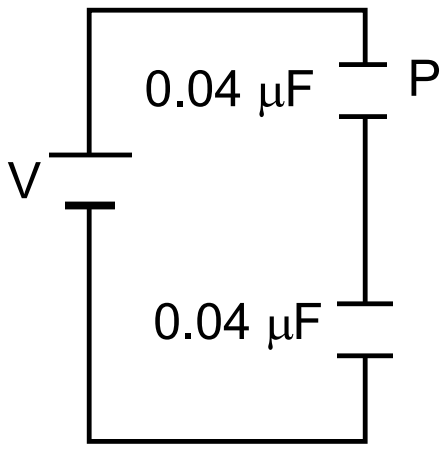
The particle P shown in figure has a mass of 10mg and a charge of $-0.01\mu\text{C}.$ Each plate has a surface area 100cm2 on one side. What potential difference V should be applied to the combination to hold the particle P in equilibrium?

What is the minimum energy that must be given to a H atom in ground state so that it can emit an $\text{H}_\gamma$ line in Balmer series. If the angular momentum of the system is conserved, what would be the angular momentum of such $\text{H}_\gamma$ photon?