Question
Clear, transparent water is always fit for drinking. Comment.

Answer

Clear, transparent water is not always fit for drinking. This is because the water which looks clean might contain disease-carrying microorganisms and dissolved impurities in it. These microorganisms and impurities could be harmful to us. Hence, it is essential to purify water before drinking.

Need a full question paper?

Generate a complete, print-ready paper with questions like this in minutes — across 16+ boards, with answer keys.
Start Generating Free

Similar questions

Explain why, even clear, transparent and odourless water may not always be safe for drinking.
It is much easier to burst an inflated balloon with a needle than by a finger. Explain.
Explain the difference between pure air and polluted air.
State two physical properties on the basis of which metals can be distinguished from non-metals.
Salma had a very soft and smooth skin during her childhood. As she entered adolescence, she developed pimples on her face. The skin specialist advised her to wash her face at regular intervals. Can you explain the reasons for the appearance of pimples on her face and suggest ways to prevent them?
What$-$is potable water? Name any two methods to make water safe for drinking.
What is the number of main stars in the Cassiopeia constellation? Draw a diagram of Cassiopeia constellation to show the position of main stars in it.
Give reasons for the following.
(i) Fresh milk is boiled before consumption while processed milk is stored in packets and can be consumed without boiling.
(ii) Raw vegetables and fruits are kept in refrigerators, whereas jams and pickles can be kept outside.
(iii) Farmers prefer to grow beans and peas in nitrogen deficient soils.
(iv) Mosquitoes can be controlled by preventing stagnation of water though they do not live in water. Why ?
Why is it advised that industries should switch over to cleaner fuels such as $CNG$ and $LPG$ in the Taj Mahal zone in Agra?
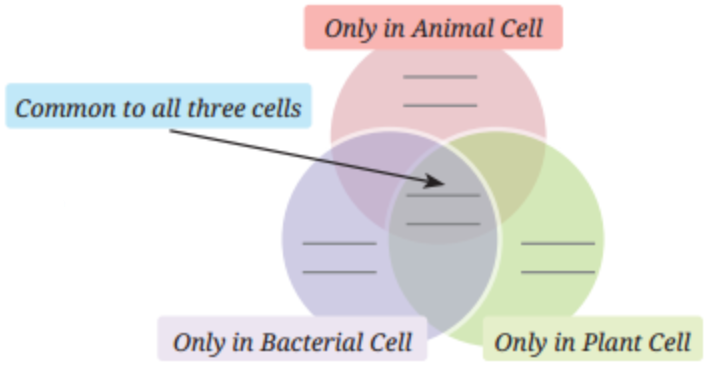
Various parts of a cell are given below. Write them in the appropriate places in the following diagram.
Image
1. Nucleus
2. Cytoplasm
3. Chloroplast
4. Cell wall
5. Cell membrane
6. Nucleoid