MCQ
Coefficient of performance for heat pump is $($when heat supplied by system is $Q_1):$
  • $\alpha=\frac{\text{Q}_2}{\text{W}}$
  • B
    $\alpha=\frac{\text{Q}_1}{\text{W}}$
  • C
    $\alpha=\frac{\text{Q}_1}{\text{Q}_2}$
  • D
    $\alpha=\frac{\text{Q}_2}{\text{Q}_1}$
Answer

Correct option: A.
$\alpha=\frac{\text{Q}_2}{\text{W}}$

Need a full question paper?

Generate a complete, print-ready paper with questions like this in minutes — across 16+ boards, with answer keys.

Start Generating Free

Similar questions

The formula $X = 5YZ^2$,  $X$ and $Z$ have dimensions of capacitance and magnetic field respectively. What are the dimensions of $Y$ in $SI$ units?
Conservation laws are such that:
In the formula $x = 3 yz^2, x$ and $z$ have dimensions of capacitance and magnetic induction, respectively. The dimensions of $y$ in $\ce{MKS}$ system are:
A metallic wire of length $L$ is fixed between two rigid supports. If the wire is cooled through a temperature difference $\Delta T$ ($Y$ = young’s modulus, $\rho$ = density, $\alpha$ = coefficient of linear expansion) then the frequency of transverse vibration is proportional to : 
A truck moving on horizontal road towards east with velocity $20\, ms^{-1}$ collides elastically with a light ball moving with velocity $25\, ms^{-1}$ along west. The velocity of the ball just after collision
When a massive body suffers an elastic collision with a stationary light body, then massive body approximately comes to rest and light body-
The driver of a car travelling at velocity $v$ suddenly see a broad wall in front of him at a distance $d$. He should
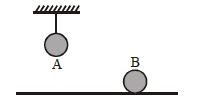
Two identical balls, $A$ and $B$ , of uniform composition and initially at the same temperature, each absorb exactly the same amount of heat. $A$ is hanging down from the ceiling while $B$ rests on the horizontal floor in the same room. Assuming no subsequent heat loss by the balls, which of the following statements is correct about their final temperatures, $T_A$ and $T_B$ , once the balls have reached their final state?
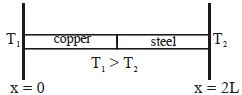
A copper rod and a steel rod of equal cross-sections and lengths $(L)$ are joined side by side and connected between two heat baths as shown in the figure

If heat flows through them from $x = 0$ to $x = 2L$ at a steady rate and conductivities of the metals are $K_{cu}$ and $K_{steel}$ $(K_{cu} > K_{steel}),$ then the temperature varies as (convection and radiation are negligible)

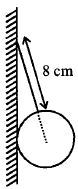
A uniform sphere of weight $W$ and radius $5\, cm$ is being held by a string as shown in the figure. The tension in the string will be