MCQ
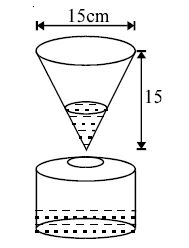
Coffee is draining from a conical filter, height and diameter both $15 \,\,cms$ into a cylinderical coffee pot diameter $15 \,\,cm$. The rate at which coffee drains from the filter into the pot is $100 \,\,cu cm /min$.The rate in $cm s/min$ at which the level in the pot is rising at the instant when the coffee in the pot is $10 \,\,cm$, is
  • A
    $\frac{9}{16\pi }$
  • B
    $\frac{25}{9\pi }$
  • C
    $\frac{5}{3\pi }$
  • $\frac{16}{9\pi }$

Answer

Correct option: D.
$\frac{16}{9\pi }$
d
For cylindrical pot  $V = \pi r^2h$

$\frac{{dV}}{{dt}} = \pi \left[ {{r^2}\frac{{dh}}{{dt}} + h\,\cdot\,2r\frac{{dr}}{{dt}}} \right]$(r = constant, $\frac{{dr}}{{dt}} = 0$)

hence,$100 = \pi r^2\frac{{dh}}{{dt}}$

$100 = \pi · \frac{{225}}{4} · \frac{{dh}}{{dt}}$(r = $\frac{{15}}{{2}} cm$)

$\frac{{dh}}{{dt}} = \frac{{400}}{{225\pi }} = \frac{{16}}{{9\pi }} cm/min$

Need a full question paper?

Generate a complete, print-ready paper with questions like this in minutes — across 16+ boards, with answer keys.

Start Generating Free

Similar questions

If $\int \frac{\cos x d x}{\sin ^{3} x\left(1+\sin ^{6} x\right)^{2 / 3}}=f(x)\left(1+\sin ^{6} x\right)^{1 / \lambda}+c$ where $c$ is a constant of integration, then $\lambda f\left(\frac{\pi}{3}\right)$ is equal to
 $(i)$  $f (x)$ is continuous and defined for all real numbers

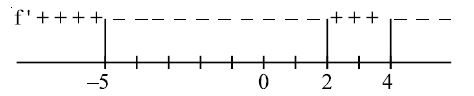
$(ii)$ $f '(-5) = 0 \,; \,f '(2)$ is not defined and $f '(4)  = 0$

$(iii)$ $(-5, 12)$ is a point which lies on the graph of $f (x)$

$(iv)$ $f ''(2)$ is undefined, but $f ''(x)$ is negative everywhere else.

$(v)$ the signs of  $f '(x)$ is given below

Possible graph of $y = f (x)$ is

$\int {\frac{{dx}}{{5 + 4\cos x}}} $ $= \lambda\, \tan^{-1}$ $\left( {m\tan \frac{x}{2}} \right)$ $+ C$ then :
Area of the region bounded by the curve $y^2=4 x, Y$-axis and the line $y=3$ is _________.
Let $f (x) =$ $\frac{{{\text{g}}\,(x)}}{{{\text{h}}\,(x)}}$, where $g $ and $h$ are cotinuous functions on the open interval $(a, b)$. Which of the following statements is true for $a < x < b$ ?
If $\frac{\text{d}}{\text{dx}}[\text{x}^\text{n}-\text{a}_1\text{x}^{\text{n}-1}+\text{a}_2\text{x}^{\text{n}-2}+...+(-1)^\text{n}\text{a}_\text{n }]\text{e}^\text{x}=\text{x}^\text{n}\ \text{e}^\text{x},$ then the value of a, 0 < r < is equals to:
  1. $\frac{\text{n}!}{\text{r}!}$
  2. $\frac{(\text{n}-\text{r})!}{\text{r}!}$
  3. $\frac{\text{n}!}{(\text{n}-\text{r})!}$
  4. $\text{None of these}$
If $p = \frac{{b \times c}}{{[a\,b\,c]}},\,\,q = \frac{{c \times a}}{{[a\,b\,c]}},\,\,r = \frac{{a \times b}}{{[a\,b\,c]}},\,\,$where $a, b, c $ are three non-coplanar vectors, then the value of $(a + b + c)\,.\,(p + q + r)$ is given by
The derivative of $y = {x^{\ln x}}$ is
Can two different vectors have the same magnitude:
  1. Yes
  2. No
  3. Cannot be determined
  4. None of the above
Choose the correct answer in each of the following:
If A and B are two events such that P(A) ≠ 0 and P(B | A) = 1, then
  1. $\text{A}\subset\text{B}$
  2. $\text{B}\subset\text{A}$
  3. $\text{B}=\phi$
  4. $\text{A}=\phi$