MCQ
Collin’s reagent is
  • A
    $MN{O_2}/HCl$
  • B
    $MN{O_4}/{C_5}{H_5}N$
  • C
    ${K_2}C{r_2}{O_7}/{H_2}S{O_4}$
  • $C{r_2}{O_3}/2{C_5}{H_5}N$

Answer

Correct option: D.
$C{r_2}{O_3}/2{C_5}{H_5}N$
d
It’s Obvious.

Need a full question paper?

Generate a complete, print-ready paper with questions like this in minutes — across 16+ boards, with answer keys.

Start Generating Free

Similar questions

${\lambda _{ClC{H_2}COONa}} = 224\;oh{m^{ - 1}}\,c{m^2}\,gme{q^{ - 1}}$,

${\lambda _{NaCl}} = 38.2\;oh{m^{ - 1}}\,c{m^2}\,gme{q^{ - 1}}$,

${\lambda _{HCl}} = 203\;oh{m^{ - 1}}\,c{m^2}\,gme{q^{ - 1}}$,

What is the value of ${\lambda _{ClC{H_2}COOH}}$ .............. ${\rm{Oh}}{{\rm{m}}^{ - 1}}{\mkern 1mu} {\rm{c}}{{\rm{m}}^2}{\rm{gm}}\,{\rm{e}}{{\rm{q}}^{ - 1}}$

Solid Lead nitrate is dissolved in $1\,litre$ of water. The solution was found to boil at $100.15^{\circ}\,C$. When $0.2\,mol$ of $NaCl$ is added to the resulting solution, it was observed that the solution froze at $-0.8^{\circ}\,C$. The solutbility product of $PbCl _2$ formed is $...........\times 10^{-6}$ at $298\,K$. (Nearest integer) Given : $K _{ b }=0.5\,K\,kg\,mol ^{-1}$ and $K _{ f }=1.8\,kg\,mol ^{-1}$. Assume molality to be equal to molarity in all cases.
The boiling points at atmospheric pressure of $HF, H_2S, NH_3$ can be  arranged in the following order
Which of the following graph is correct representation between atomic number $(Z)$ and magnetic moment of $d-block$ elements? [Outer electronic configuration : $(n -1)d^x\, ns^{1\, or \,2}$]
Which of the following is lewis acid
The increasing order of $pK _{ b }$ values of the following compounds is 
In balmer series of lines of hydrogen spectrum, the third line from the red end corresponds to which one of the following inter-orbit jumps of the electron for Bohr orbits in an atom of hydrogen
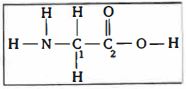
What are the hybridisation of the carbon atoms labeled $C_1$ and $C_2$, respectively in glycine?

$C_1$          $C_2$

For a gaseous reaction $Cl_2(g) + PCl_3(g) \to PCl_5(g)$ If $10\, mL$ of $Cl_2$ completely react with $PCl_3$ then find out produced volume of $PCl_5$. .............. $\mathrm{mL}$
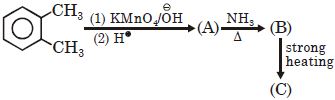
The product $(C)$ will be