MCQ
Colours observed on a CD (Compact Disk) is due to
  • A
    Reflection
  • B
    Diffraction
  • C
    Dispersion
  • D
    Absorption

Answer

(b) Diffraction

Need a full question paper?

Generate a complete, print-ready paper with questions like this in minutes — across 16+ boards, with answer keys.
Start Generating Free

Similar questions

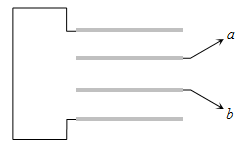
Four metallic plates each with a surface area of one side A are placed at a distance d from each other. The plates are connected as shown in the circuit diagram. Then the capacitance of the system between a and b is
       
An electron moves with a constant velocity $v$ in a uniform magnetic field $B,$ parallel to the direction of the magnetic field. The force acting on electron is:
The graph that correctly represents the relation of frequency $v$ of a particular characteristic $X-$ ray with the atomic number $Z$ of the material is
The acceleration of an electron in an electric field of magnitude $50\, V/cm$, if $e/m$ value of the electron is $1.76 \times {10^{11}}\,C/kg$, is
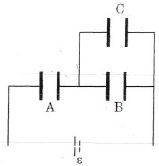
Three capacitors $A,B$ and $C$ are connected with battery $emf\, \varepsilon $. All capacitors are identical initially. If dielectric slab is inserted between plates of capacitor $A$ slowy with help of external force then 
Assertion : Electric field outside the conducting wire which carries a constant current is zero.
Reason : Net charge on conducting wire is zero.
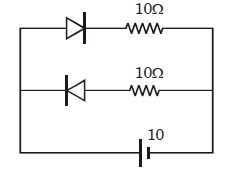
Reverse break down voltage for silicon diode is $6\ V$ for a particular doping concentration and forward break down voltage is $0.3\ V$ then find approximate current through battery in the given circuit....$Amp$
The magnitude of gravitational potential energy of the moon-earth system is U with zero potential energy at infinite separation. The kinetic energy of the moon with respect to the earth is K.
The line that draws power supply to your house from street has:
In a plane electromagnetic wave, which of the following has/ have zero average/value in one complete cycle?

$(a)$ Magnetic field

$(b)$ Magnetic energy

$(c)$ Electric field

$(d)$ Electric energy