Question
Column AColumn B (Organisms)
1. Symbiotic nitrogen fixationa. Nitrobacter
2. Denitrificationb. Cyanobacteria
3. Free living nitrogen fixersc. Rhizobium
4. Nitrificationd. Paracoccus

Answer

Column AColumn B (Organisms)
1. Symbiotic nitrogen fixationc. Rhizobium
2. Denitrificationd. Paracoccus
3. Free living nitrogen fixersb. Cyanobacteria
4. Nitrificationa. Nitrobacter

Need a full question paper?

Generate a complete, print-ready paper with questions like this in minutes — across 16+ boards, with answer keys.

Start Generating Free

Similar questions

Match the terms in Column I with those in Column II.
S. No Column I S. No Column II
(i) Gene therapy 1. Human insulin.
(ii) Cotton bollworm 2. Biopiracy.
(iii) Eli Lilly 3. Emphysema.
(iv) Basmati Rice 4. ADA deficiency.
(v) $\alpha-1\text{ antitrypsin}$ 5. Lepidopteran.
Distinguish between: Morula and Blastula.
Diffusion and Osmosis.
Column AColumn B
(1) Walter Rosen(a) Popularisation of term biodiversity
(2) David Tillman(b) Rivet Popper Hypothesis
(3) Paul Ehrlich(c) Productivity Stability Hypothesis
(4) Edward Wilson(d) Coined
Column IColumn II
(1) Mechanical means(a) Saheli
(2) Physiological device(b) Jellies
(3) Chemical device(c) Vasectomy
(4) Permanent method(d) Diaphragm
Read the following and answer any four questions from (i) to (v) given below:
When it comes to biopesticides, one of the most widely used fungi is Beauveria bassiana. It infects a range of insects like, pecan weevil, Colorado potato beetle, kudzu bug, etc. It causes a disease known as the white muscardine. Even after an insect is killed, the white mold continues to produce millions of new infective spores that are released into the environment. It is commercially formulated as products including Naturalis L, Mycotrol, BotaniGard, etc. Some other widely used molds are Trichoderma, Metarhizium, etc. Some of them release enzymes that dissolve potential pathogens, others form barriers around plant roots and make it impossible for harmful bacteria and pathogens to pass through.
  1. The key benefits of the biopesticides are that they are:
  1. Highly effective.
  2. Target specific.
  3. Reduced environmental risks.
  4. all of these.
  1. Naturalis-L is a conunercial formulation containing:
  1. Bacterial biopesticide.
  2. Fungal biopesticide.
  3. Fungal biofertiliser.
  4. Chemical pesticide.
  1. Which of the following is used as an effective bacterial biopesticide?
  1. Trichoderma.
  2. Beauveria.
  3. Bacillus thuringiensis.
  4. All of these.
  1. Baeuveria causes a disease called:
  1. White muscardine.
  2. Aspergillosis
  3. Green muscardine.
  4. Powdary mildews.
  1. Assertion: Trichoderma, found in root ecosystem, exerts biological control over several plant pathogens.
Reason: Trichoderma release enzyme which inhibits growth of several disease causing pathogens.
  1. Both assertion and reason are true and reason is the correct explanation of assertion.
  2. Both assertion and reason are true but reason is not the correct explanation of assertion.
  3. Assertion is true but reason is false.
  4. Both assertion and reason are false.
Read the following and answer any four questions from (i) to (v) given below:
A typical angiospermic ovule is a small structure attached to the placenta by means of a stalk called funicle. The body of the ovule fuses with funicle in the region called hilum. Each ovule has one or two protective envelopes called integuments. Integuments encircle the nucellus except at the tip where a small opening called the micropyle is formed. Mature ovules are classified on the basis of funiculus. It can be orthotropous, anadromous, hernitropous, campylotropous, etc.
  1. The body of the ovule consists of a mass of parenchymatous cells called:
  1. Integuments.
  2. Nucellus.
  3. Hilum.
  4. Funiculus.
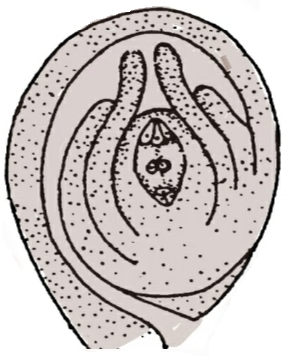
  1. Refer to the given figure and select the correct statement regarding it.
  1. This type of ovule is found in cactus.
  2. The micropyle comes to lie close to the funiculus due to unilateral growth of ovule.
  3. It is most common type of ovule found in the members of Chenopodiaceae.
  4. It is half inverted ovule.
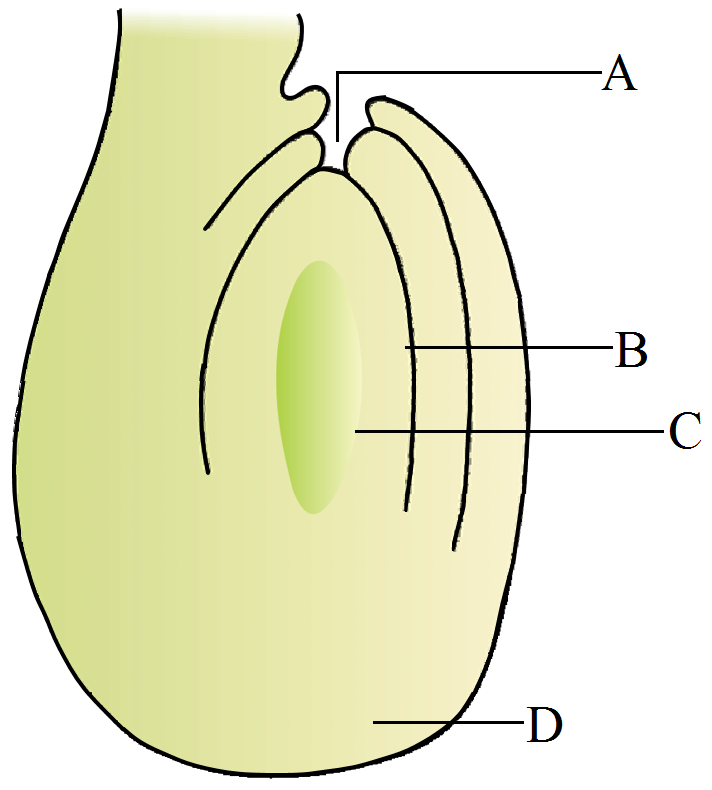
  1. Identify the parts labelled as A, B, C and D in the given figure and select the correct option.
S. No A B C D
(a) Chalaza Female gametophyte Embryo sac Micropyle
(b) Chalaza NuceIIus Embryo sac Micropyle
(c) Micropyle Egg Embryo sac Chalaza
(d) Micropyle Nucellus Embryo sac Chalaza
  1. Mature ovules are classified on the basis of funiculus. If micropyle lie close to the funiculus, the ovule is termed as:
  1. Orthotropous.
  2. Anatropous.
  3. Hemitropous.
  4. Campylotropous.
  1. In Asphodel us, ovule is:
  1. Unitegmic.
  2. Tritegmic.
  3. Bitegmic.
  4. Ategmic.
Read the following and answer any four questions from (i) to (v) given below:
Study the given table and answer the questions based on it.
 
Hormone
Source
Function
(A)
Oxytocin
W
Ejection of milk
(B)
X
Anterior lobe of pituitary gland
Stimulates secretion of ABP from Sertoli cells
(C)
Y
Placenta
Maintains corpus luteum to secrete progesterone
(D)
Relaxin
Ovary
Z
  1. Identify the hormones X and Y, respectively.
  1. Testosterone, FSH.
  2. LH, hPL.
  3. FSH, hCG.
  4. ICSH, hCG.
  1. W in the given table is:
  1. Hypothalamus.
  2. Posterior lobe of pituitary.
  3. Placenta.
  4. Ovary.
  1. Which of the following is correct for Z?
  1. Dilation of uterine cervix during labour pains.
  2. Stimulates the growth of the mammary glands during pregnancy.
  3. Supports the fetal growth and prevents desiccation.
  4. Forms protective plug in cervix of uterus during pregnancy.
  1. Which set of hormones is secreted only during pregnancy?
  1. Human chorionic gonadotropin, relax in and human placental lactogen.
  2. Human placental lactogen, estrogen and chorionic thyrotropin.
  3. Human chorionic gonadotropin, human placental lactogen and progesterone.
  4. Chorionic thyrotropin, chorionic gonadotropin and estrogen.
  1. Assertion: Follicle stimulating hormone controls the maintenance and functions of male reproductive organs.
Reason: FSH acts directly on spermatogonia to stimulate sperm production.
  1. Both assertion and reason are true, and reason is the correct explanation of assertion.
  2. Both assertion and reason are true, but reason is not the correct explanation of assertion.
  3. Assertion is true, but reason is false.
  4. Both assertion and reason are false.
Read the following and answer any four questions from (i) to (v) given below:
ABO blood groups in human beings are controlled by the gene. The gene I has three alleles. $I^A, I^B$ and $i$. Since there are three different alleles six different genotypes are possible. If two persons with 'AB' blood group marry and have sufficient large number of children, there children could be classified as 'A: blood group : 'AB' blood group : B blood group in $1 : 2 : 1$ ratio. Modern technique of protein electrophoresis reveals presence of both 'A and 'B' type proteins in 'AB' blood group individuals.
  1. How many types of phenotypes can occur in ABO blood group?
  1. Six
  2. Two
  3. Three
  4. Four
  1. ABO blood grouping in human beings cites the example of.
  1. Incomplete dominance.
  2. Co-dominance.
  3. Multiple allelism.
  4. both (b) an (c).
  1. The presence of both 'X and 'B' type proteins in 'AB' blood group individuals is an example of.
  1. Partial dominance.
  2. Incomplete dominance.
  3. Co-dominanc.
  4. complete dominance.
  1. If a man of A blood group marries a woman of AB blood group. Which type of progeny indicates that man is heterozygous?
  1. O
  2. B
  3. A
  4. AB
  1. Complete the given table regarding different possibilities and their corresponding blood groups.
Genotypes
Blood group
$I^AI^B$
$(I)$
$I^B i, (II)$
$B$
$(III)$
$O$
$I^A I^A, (IV)$
$I^A$
 
 
(I)
(II)
(III)
(IV)
(a)
O
$I^B I^B$
$I^B i$
$I^A i$
(b)
AB
$I^A i$
$I^A I^B$
$IBi$
(c)
AB
$I^B I^B$
$ii$
$I^A i$
(d)
O
$I^A I^A$
$ii$
$I^A i$
Distinguish between : Pharynx and Larynx.