Question
Column AColumn B
(a)Highly reactive metals1.Oxides are broken by direct heating.
(b)Moderately reactive metals2.Occur in free state.
(c )Hg and Ag3.Extracted by reduction using suitable reducing agents.
(d)Pt and Au4.Extracted by electrolytic reduction.

Answer

(a) 4, (b) 3, (c ) 1, (d) 2

Need a full question paper?

Generate a complete, print-ready paper with questions like this in minutes — across 16+ boards, with answer keys.

Start Generating Free

Similar questions

Column AColumn B
(a)Molar Mass1.6.022 × 1023 particles/mol
(b)Avogadro's Number2.Simplest whole-number ratio of elements in a compound
(c )Empirical Formula3.The maximum amount of product that can be formed from the given reactants
(d)Molecular Formula4.The mass of one mole of a substance
5.The actual formula of a molecule showing the number of atoms of each element
Match the salts given in Column I with their method of preparation given in Column II:
Column I Column II
(i) $P(NO_3)_2$ from $PbO$
(ii) $MgCl_2$ from $Mg$
(iii) $FeCl_3$from $Fe$
(iv) $NaNO_3$ from $NaOH$
(v) $ZnCO_3$ from $ZnSO_4$​​​​​​​
(A) Simple displacement
(B) Titration
(C) Neutralisation
(D) Precipitation
(E) Combination
Column AColumn B
(1) Acid Salt(a) Ferrous ammonium sulphate
(2) Double Salt(b) Contains only ions
(3) Ammonium hydroxide solution(c) Sodium hydrogen sulphate
(4) Dilute hydrochloric(d) Contains only molecules
 (e) Contains ions and molecules
Column AColumn B
(1) Acid salt(a) Sodium potassium carbonate
(2) Mixed salt(b) Alum
(3) Complex salt(c) Sodium carbonate
(4) Double salt(d) Sodium zincate
 (e) Sodium hydrogen carbonate
Column AColumn B
(a) Boiling point of liquid HCl1. Orange to Pink
(b) Melting point of liquid HCl2. Pink to colourless
(c) Effect of HCl on litmus solution3. -85°C
(d) Effect of HCl on methyl orange solution4. Blue to Red
5. -115°C
Column AColumn B
(1) Covalent compound(a) Methane (CH4)
(2) Non-polar(b) Sodium chloride $( NaCl )$
(3) Polar(c) Chloride ion ( $Cl -$ )
(4) Electrovalent compound(d) Carbon dioxide (CO2)
 (e) Hydrogen chloride ( HCl )
Column AColumn B
(a) Sodium chloride1. Increases
(b) Ammonium ion2. Decreases
(c) Electronegativity across the period3. Ionic bond
(d) Non-metallic character down the group4. Covalent and Coordinate bond
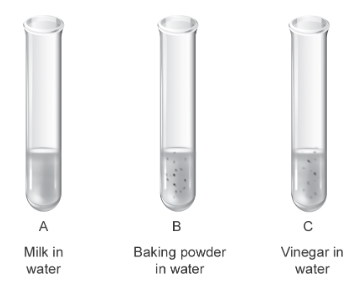
Given below in column A are different solutions in test tubes, which is checked using litmus paper. Identify the solutions labelled as A, B and C with the correct options from the column B.
Column AColumn B
Image(1) No change in colour of litmus paper
(2) Litmus paper turns to blue
(3) Litmus paper turns to red
(4) Litmus paper turns to green