MCQ
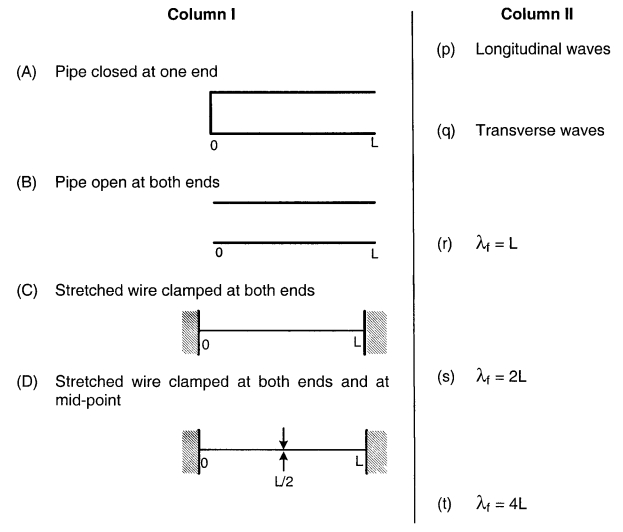
Column $I$ shows four systems, each of the same length $L$, for producing standing waves. The lowest possible natural frequency of a system is called its fundamental frequency, whose wavelength is denoted as $\lambda_{ f }$. Match each system with statements given in Column $II$ describing the nature and wavelength of the standing waves.
  • A
    $(A) \rightarrow p, r, \ and \ t,(B) \rightarrow p \ and \ q (C) \rightarrow q, \ and \ s,(D) \rightarrow  r \ and \ s$
  • B
    $(A) \rightarrow q \ and \ t,(B) \rightarrow r \ and \ s (C) \rightarrow p, \ and \ s,(D) \rightarrow  q \ and \ t$
  • $(A) \rightarrow p \ and \ t,(B) \rightarrow p \ and \ s (C) \rightarrow q, \ and \ s,(D) \rightarrow  q \ and \ r$
  • D
    $(A) \rightarrow q \ and \ t,(B) \rightarrow r \ and \ t (C) \rightarrow q \ and \ s,(D) \rightarrow  s \ and \ t$
Answer

Correct option: C.
$(A) \rightarrow p \ and \ t,(B) \rightarrow p \ and \ s (C) \rightarrow q, \ and \ s,(D) \rightarrow  q \ and \ r$
c
In case of pipe we can produce longitudinal waves and for strings we produce transverse waves.

$A \rightarrow(p, t):$ It is a closed organ pipe hence in case of fundamental vibrations length of the tube must be $\left(\frac{1}{4}\right)^{\text {th }}$ of the wavelength (half loop).

$\frac{\lambda_t}{4}=L \Rightarrow \lambda_t=4 L$

$B \rightarrow(p, s)$ : It is open organ pipe hence in case of fundamental vibrations length of the pipe must be half of the wavelength (one loop).

$\frac{\lambda_t}{2}=L \Rightarrow \lambda_t=2 L$

$C \rightarrow(q, s)$ : It is a case of string of length $L$ fixed at both ends.

In case of fundamental vibrations length of the pipe must be half of the wavelength (one loop).

$\frac{\lambda_t}{2}=L \Rightarrow \lambda_t=2 L$

$D \rightarrow(q, r):$ In this case mid-point is fixed hence half-length must form one loop.

$\frac{\lambda_t}{2}=\frac{L}{2} \Rightarrow \lambda_t=L$

Need a full question paper?

Generate a complete, print-ready paper with questions like this in minutes — across 16+ boards, with answer keys.

Start Generating Free

Similar questions

The magnitude of potential energy per unit mass of an object at the surface of earth is $E$, then the escape velocity of the object is ..........
Which of the following is not the unit of time
$1 \,kg$ of ice at $-20^{\circ} C$ is mixed with $2 \,kg$ of water at $90^{\circ} C$. Assuming that there is no loss of energy to the environment, the final temperature of the mixture is ............ $^{\circ} C$ (Assume, latent heat of ice $=334.4 \,kJ / kg$, specific heat of water and ice are $4.18 \,kJ kg ^{-1} K ^{-1}$ and $2.09 \,kJ kg ^{-1}- K ^{-1}$, respectively.)
A simple pendulum is executing simple harmonic motion with a time period $T$. If the length of the pendulum is increased by $21\%$, the percentage increase in the time period of the pendulum of increased length is ..... $\%$
A body of length 1m having cross sectional area $0.75\;m^2$ has heat flow through it at the rate of $ 6000\; Joule/sec$ . Then find the temperature difference if $K = 200\;J{m^{ - 1}}{K^{ - 1}}$ ...... $^oC$
A cube has a side of length $1.2 \times 10^{-2}\; m$. Calculate its volume.
The ratio of the radii of planets $A$ and $B$ is ${k_1}$ and ratio of acceleration due to gravity on them is ${k_2}$. The ratio of escape velocities from them will be
The work done by a force $\vec F = \left( { - 6{x^3}\hat i} \right)\,N$, in displacing a particle from $x = 4\, m$ to $x = -2\, m$ is  ................ $\mathrm{J}$
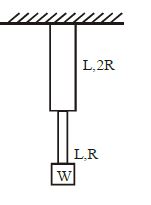
Two wires of the same material (Young's modulus  $Y$ ) and same length $L$  but radii  $R$  and  $2R$  respectively are joined end to end and a weight  $W$  is suspended from the combination as shown in the figure. The elastic potential energy in the system is
A spherical body of mass $100 \mathrm{~g}$ is dropped from a height of $10 \mathrm{~m}$ from the ground. After hitting the ground, the body rebounds to a height of $5 \mathrm{~m}$. The impulse of force imparted by the ground to the body is given by : (given $\mathrm{g}=9.8 \mathrm{~m} / \mathrm{s}^2$ )