Question
| Column I | Column II |
| 1. Vibrio | a. Rod-shaped |
| 2. Bacillus | b. Spherical |
| 3. Spirillum | c. Spiral shaped |
| d. Comma or kidney-shaped |
| Column I | Column II |
| 1. Vibrio | a. Rod-shaped |
| 2. Bacillus | b. Spherical |
| 3. Spirillum | c. Spiral shaped |
| d. Comma or kidney-shaped |
| Column I | Column II |
| 1. Vibrio | d. Comma or kidney-shaped |
| 2. Bacillus | a. Rod-shaped |
| 3. Spirillum | c. Spiral shaped |
Generate a complete, print-ready paper with questions like this in minutes — across 16+ boards, with answer keys.
| Column I (Organism) | Column II (Characteristic Feature) |
| 1. Euplectella | (a) Exoskeleton formed of placoid scales |
| 2. Periplaneta | (b) Presence of mantle |
| 3. Sepia | (c) Water canal system |
| 4. Scoliodon | (d) Jointed appendages |
| 5. Clarias | (e) Exoskeleton formed of cycloid scales |
| Column I | Column II |
| 1. Composite fruit | (a) Custard apple |
| 2. Parthenocarpic fruit | (b) Cultivated Banana |
| 3. Aggregate fruit | (c) Mango |
| (d) Pineapple |
| Column I | Column II |
| 1. Mitochondria | (a) Synthesis of protein |
| 2. Nucleus | (b) Photosynthesis |
| 3. Chloroplast | (c) Respiration |
| 4. Ribosomes | (d) Nucleoplasm |
| Column-I | Column-II |
| 1. Basal | (p) Mustard |
| 2. Axile | (q) China rose |
| 3. Parietal | (r) Dianthus |
| 4. Free central | (s) Sunflower |
| Column I | Column II |
| (a) Golgi apparatus | (i) Synthesis of protein |
| (b) Lysosomes | (ii) Trap waste and excretory products |
| (c) Vacuoles | (iii) Formation of glycoproteins and glycolipids |
| (d) Ribosomes | (iv) Digesting biomolecules |
| Column I | Column II |
| 1. Bryophyta | (a) 70 genera and 1000 living species |
| 2. Pteridophyta | (b) 32 genera and 80 species |
| 3. Gymnospermae | (c) 960 genera and 25000 species |
| (d) 400 genera and 11000 species |
| Column I | Column 11 |
| 1. RNA | (a) Induced fit model |
| 2. Yam plant | (b) Flax seeds |
| 3. Koshland | (c) Hydrolase |
| 4. Omega – 3 – fatty acid | (d) Uracil |
| 5. Sucrase | (e) Anti-fertility pills |
| i. | Descending limb of Henle’s loop | a. | Reabsorption of salts only |
| ii. | Proximal convoluted tubule | b. | Reabsorption of water only |
| iii. | Ascending limb of Henle’s loop | c. | Conditional reabsorption of sodium ions and water |
| iv. | Distal convoluted tubule | d. | Reabsorption of ions, water and organic nutrients |
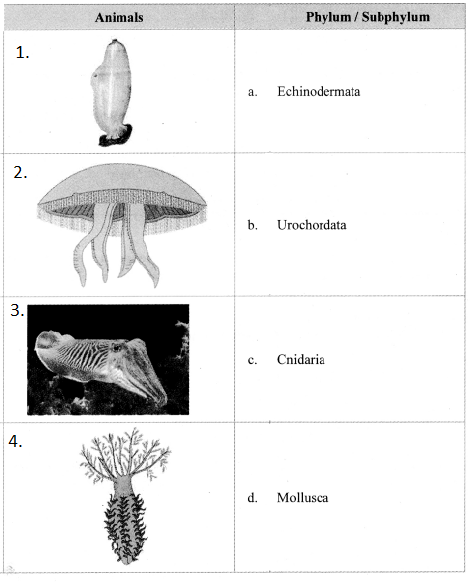
| Column-I | Column-II | ||
| i. | Podocytes | a. | Crystallised oxalates |
| ii. | Protonephridia | b. | Annelids |
| iii. | Nephridia | c. | Amphioxus |
| iv. | Renal calculi | d. | Filtration slits |