MCQ
Column$-II$ is related to Column$-I$. Join them appropriately :
Column $-I$  Column $-II$ 
$(a)$ When temperature raised Young’s modulus of body $(i)$ Zero
$(b)$ Young’s modulus for air $(ii)$ Infinite
  $(iii)$ Decreases
  $(iv)$Increases
  • A
    $(a-ii),(b-i)$
  • $(a-iii),(b-i)$
  • C
    $(a-ii),(b-iv)$
  • D
    $(a-iii),(b-ii)$

Answer

Correct option: B.
$(a-iii),(b-i)$
b
$(\mathrm{a}-\mathrm{iii}),(\mathrm{b}-\mathrm{i})$

Need a full question paper?

Generate a complete, print-ready paper with questions like this in minutes — across 16+ boards, with answer keys.

Start Generating Free

Similar questions

The components of $\vec a = 2\hat i + 3\hat j$ along the direction of vector $\left( {\hat i + \hat j} \right)$ is
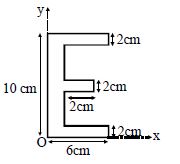
The $(x -y)$ co-ordinates $(in\ cm)$ of the centre of mass of letter $E$ relative to the origin $O$ , whose dimensions are shown in the figure is :
(Take width of the letter $2\ cm$ every where) :
A calorimeter contains $0.2\, kg$ of water at $30\,^oC$, $0.1\,kg$ of water at $60\,^oC$ is added to it, the mixture is well stirred and the resulting temperature is found to be $35\,^oC$. The thermal capacity of calorimeter is .......... $J/K$
Spacing between two successive nodes in a standing wave on a string is $x$ . If frequency of the standing wave is kept unchanged but tension in the string is doubled, then new spacing between successive nodes will  become
The motion of a particle varies with time according to the relation $y = a(\sin \omega \,t + \cos \omega \,t)$, then
If two tuning forks $A$ and $B$ are sounded together, they produce $4$ beats per second. $A$ is then slightly loaded with wax, they produce $2$ beats when sounded again. The frequency of $A$ is $256.$ The frequency of $B$ will be
A simple pendulum with length  $L$ and mass $m$ of the bob is vibrating with an amplitude $A$. The maximum tension in the string is
Two particles of masses $M$ and $4M$ are released from a distance $10\,metres$ from each other. Find the point of collision from smaller particle .............. $\mathrm{metres}$
At some temperature $T$, a bronze pin is a little large to fit into a hole drilled in a steel block. The change in temperature required for an exact fit is minimum when
In the relation $n = \frac{{PV}}{{RT}},n = $