Question
Compare and explain three distinguishing features observed in Young’s double slit interference pattern with those seen for a coherently illuminated single slit producing diffraction pattern.

Answer

Interference Diffraction
  1. Equally spaced fringes.
  2. All maxima have equal brightness.
  3. Formed by superposition of wavefronts from two coherent sources.
  4. There is a maxima at the angle $\lambda$/a.
  5. Quite a large number of fringes are easily observable.
  1. Fringes are not equally spaced.
  2. Intensity of maxima keeps on decreasing.
  3. Formed through superposition of wavelets from a single wavefront.
  4. First minima occurs at an angle $\lambda$/a.
  5. It becomes difficult to distinguish maxima and minima after a few fringes.

Need a full question paper?

Generate a complete, print-ready paper with questions like this in minutes — across 16+ boards, with answer keys.
Start Generating Free

Similar questions

Explain the refraction of a plane wave by
(a) a thin prism
(b) a convex lens and
(c) reflection of a plane wave by a concave mirror.
A 3.0 cm wire carrying of 10 A is placed inside a solenoid perpendicular to its axis. The magnetic field inside the solenoid is given to be 0.27 T. What is the magnetic force on the wire?
Water is filled in a rectangular tank of size $3m \times 2m \times 1m.$
  1. Find the total force exerted by the water on the bottom surface of the tank.
  2. Consider a vertical side of area $2m \times 1m.$ Take a horizontal strip of width $ox$ metre in this side, situated at a depth of $x$ metre from the surface of water. Find the force by the water on this strip.
  3. Find the torque of the force calculated in part.$(b)$ about the bottom edge of this side.
  4. Find the total force by the water on this side.
  5. Find the total torque by the water on the side about.
The bottom edge. Neglect the atmospheric pressure and take $g = 10m/s^2.$
How is a wavefront defined? Using Huygen’s construction draw a figure showing the propagation of a plane wave refracting at a plane surface separating two media. Hence verify Snell’s law of refraction.
Is $\text{p}=\frac{\text{E}}{\text{c}}$ valid for electrons?
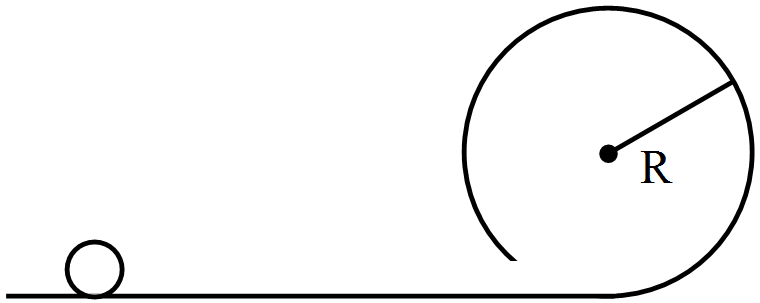
Figure shows a rough track, a portion of which is in the form of a cylinder of radius R. With what minimum linear speed should a sphere of radius r be set rolling on the horizontal part so that it completely goes round the circle on the cylindrical part.
Two sources of sound $, S_1$ and $S_2,$ emitting waves of equal wavelength $20.0\ cm,$ are placed with a separation of $20.0\ cm$ between them. A detector can be moved on a line parallel to $S_1 ,S_2,$ and at a distance of $20.0\ cm$ from it. Initially, the detector is equidistant from the two sources. Assuming that the waves emitted by the sources are in phase, find the minimum distance through which the detector should be shifted to detect a minimum of sound.
Find the
(a) Maximum frequency, and
(b) Minimum wavelength of X-rays produced by 30 kV electrons.
A current$-$carrying circular coil of $100$ turns and radius $5.0\ cm$ produces a magnetic field of $6.0 \times 10^{-5}T$ at its centre. Find the value of the current.
Arrange the following electromagnetic waves in the order of their increasing wavelength:
  1. $\gamma- \text{rays}$.
  2. Microwaves.
  3. X-rays.
  4. Radio waves.
How are infra-red waves produced? What role does infra-red radiation play in (i) Maintaining the Earth’s warmth and (ii) Physical therapy?