Question
Compare and explain three distinguishing features observed in Young’s double slit interference pattern with those seen for a coherently illuminated single slit producing diffraction pattern.

Answer

Interference Diffraction
  1. Equally spaced fringes.
  2. All maxima have equal brightness.
  3. Formed by superposition of wavefronts from two coherent sources.
  4. There is a maxima at the angle $\lambda$/a.
  5. Quite a large number of fringes are easily observable.
  1. Fringes are not equally spaced.
  2. Intensity of maxima keeps on decreasing.
  3. Formed through superposition of wavelets from a single wavefront.
  4. First minima occurs at an angle $\lambda$/a.
  5. It becomes difficult to distinguish maxima and minima after a few fringes.

Need a full question paper?

Generate a complete, print-ready paper with questions like this in minutes — across 16+ boards, with answer keys.
Start Generating Free

Similar questions

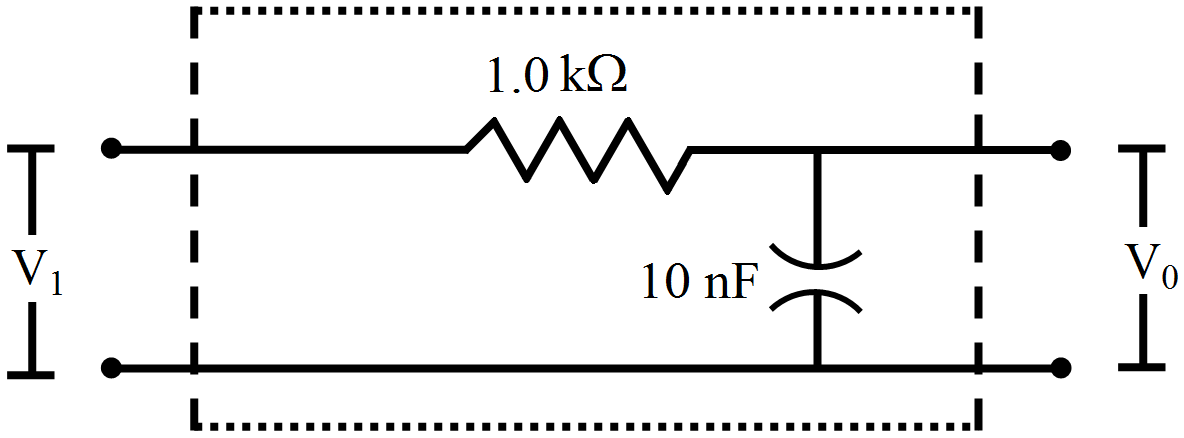
Figure shows a typical circuit for a low-pass filter. An AC input Vi = 10mV is applied at the left end and the output V0 is received at the right end. Find the output voltage for ν = 10kHz, 1.0MHz and 10.0MHz. Note that as the frequency is increased the output decreases and, hence, the name low-pass filter.

By defining conduction current, explain why Maxwell propounded the idea of displacement current?
Which wavelengths will be emitted by a sample of atomic hydrogen gas (in ground state) if electrons of energy 12.2eV collide with the atoms of the gas?
What is the parallel connection of cells ? Derive the formula for equivalent $e m f$ and equivalent internal resistance for parallel connection of cell.
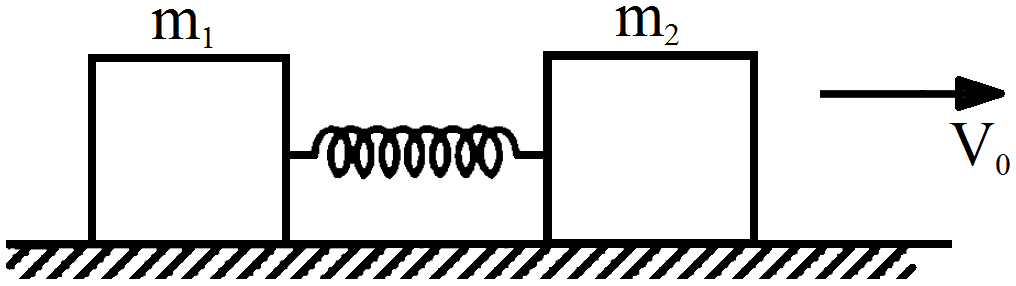
Two blocks of masses m1 and m2 are connected by a spring of spring constant k. The block of mass m2 is given a sharp impulse so that it acquires a velocity v0 towards right. Find
  1. The velocity of the centre of mass.
  2. The maximum elongation that the spring will suffer.
​​​​​​​
Two waves, travelling in the same direction through the same region, have equal frequencies, wavelengths and amplitudes. If the amplitude of each wave is 4mm and the phase difference between the waves is 90°, what is the resultant amplitude?
The work function for the following metals is given:
Na: 2.75 eV; K: 2.30 eV; Mo: 4.17 eV; Ni: 5.15 eV. Which of these metals will not give photoelectric emission for a radiation of wavelength 3300 Å from a He-Cd laser placed 1 m away from the photocell? What happens if the laser is brought nearer and placed 50 cm away?
The numerical value of ionization energy in eV equals the ionization potential in volts. Does the equality hold if these quantities are measured in some other units?
  1. Write symbolically the β decay process of$\frac{15}{32}$P.
  2. Derive an expression for the average life of a radionuclide. Give its relationship with the half-life.
A light ray, going through a prism with the angle of prism 60°, is found to deviate by 30°. What limit on the refractive index can be put from these data?