MCQ
Compare relative stability of the following resonating structure.
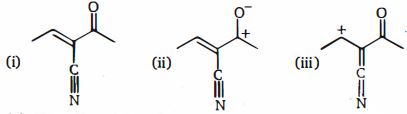
  • $(i) > (ii) > (iii)$
  • B
    $(ii) > (i) > (iii)$
  • C
    $(i) > (iii) > (ii)$
  • D
    $(ii) > (iii) > (i)$

Answer

Correct option: A.
$(i) > (ii) > (iii)$
a
$(a)$ $(1)$ Neutral $R.S.$ are most stable.
$(2)$ With the increase in charge separation stability of $R.S.$ decreases. So  stability order is $I > II > III$

Need a full question paper?

Generate a complete, print-ready paper with questions like this in minutes — across 16+ boards, with answer keys.

Start Generating Free

Similar questions

Isomers of propionic acid are
Choose the correct answer A. thermodynamic state function is a quantity
The heat of neutralization of four acids $A, B, C, D$ are $-13.0, -12.6, -9.2$ and $-11.7\, KCal/eq$ respectively when neutralized by $NaOH$. The order of acidic strength of four acids will be
Which branched chain isomer of the hydrocarbon with molecular mass $72\,u$ gives only one isomer of mono substituted alkyl halide ?
For the equilibrium ${N_2} + 3{H_2}$ $\rightleftharpoons$ $2N{H_3},{K_c}$ at $1000\,K$ is $2.37 \times {10^{ - 3}}$. If at equilibrium $[{N_2}] = 2\,M,\,[{H_2}] = 3\,M$, the concentration of $N{H_3}$ is
Match List $I$ (Equations) with List $II$ (Type of processes) and select the correct option.

$\begin{array} {|l|p{0.6\linewidth}|} \hline List\,\,I\,\,Equations  & List\,\,II\,\,Type\,\,of\,\,processes \\ \hline A. K_p > Q  & (i)\,\,Non-\,\,spontaneous  \\ \hline B.\, \Delta G^o < RT ln Q & (ii)\,\,Equilibrium \\ \hline C. K_p=Q  & (iii)\,\,Spontaneous\,\,and\,\,endothermic \\ \hline D. T > \frac{\Delta H}{\Delta S} & (iv)\,\,Spontaneous \\ \hline \end{array}$

An organic compound has $\%$ of $C$ and $\%$ of $H$ in the ratio $6 : 1$ and $\%$ of $C$ and $\%$ of $O$ in the ratio $3 : 4$. The compound is
While revolving in discrete orbits, the electrons do not radiate energy. These orbits or shells are called ________.
A solution of sulphur dioxide in water reacts with ${H_2}S$ precipitating sulphur. Here sulphur dioxide acts as
Oxidising power of chlorine in aqueous solution can be determined by the parameters indicated below :

$\frac{1}{2}C{l_2}(g)\xrightarrow{{\frac{1}{2}{\Delta _{diss}}{H^\Theta }}}Cl(g)\xrightarrow{{{\Delta _{eg}}{H^\Theta }}}$ $C{l^ - }(g)\xrightarrow{{{\Delta _{Hyd}}{H^\Theta }}}C{l^ - }(aq)$

(using the data, 

${{\Delta _{diss}}H_{C{l_2}}^\Theta } = 240\,kJ\,mol^{-1}, {{\Delta _{eg}}H_{C{l}}^\Theta }= -349 \,kJ\,mol^{-1},$${{\Delta _{Hyd}}H_{C{l}}^\Theta }= -381 \,kJ\,mol^{-1}$ ) will be ............. $\mathrm{kJ\,mol}^{-1}$