Question
Compare the Panchavayavi conjecture with the non-executive constitution.
| Panchavyavi Assumption | Unofficial constitution | ||
| $1.$ | Indian logic is an important study subject. | $1.$ | પાશ્ચાત્ય તર્કશાસ્ત્રનો મહત્ત્વપૂર્ણ અભ્યાસવિષય છે. |
| $2.$ | There are three positions, behalf, practicable and purpose. | $2.$ | There are three positions namely behalf position, attainable position and middle position. |
| $3.$ | The relationship between the party and the sadhya can be established in the corporation through the mediation of purpose. | $3.$ | The relationship between the party position and the attainable position can be established in the resultant constitution through the mediation of the mediator. |
| $4.$ | The Panchavayavi conjecture consists of five statements viz., Vow, purpose, example, scope, subdivision and incorporation. | $4.$ | The non-executive constitution has three statements namely Practicable Statement, Behalf Statement and Result Statement. |
| $5.$ | The reason for the change in the number of statements is psychological. Judges call the Panchavayavi conjecture 'altruism'. The speaker has to present five statements in a fixed order in order to make an effective presentation, both psychologically and logically. The Indian conjecture, like the non-executive constitution, can be represented by three statements. Example: Practicable Vidhan: All smokers are fire places. Behalf statement: This mountain is a place of smoke. Result statement: So this mountain is a fireplace. 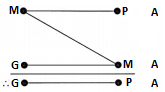 |
$5.$ | In Western logic, the first of the four figures and its distinction $‘AAA’$ is considered the best. The Indian conjecture can be distinguished from the ‘hahaha’ distinction of the first figure of the Nirupadhika Constitution. Similarly, the non-executive constitution presented in the $‘AAA’$ distinction can be presented in the form of a panchayat conjecture. Example: Pledge: Socrates is mortal. Purpose: Because he is a man. Scope including example: If a person is a man he is mortal. E.g. Gandhiji Subculture: Socrates has a humanity that is pervasive with mortality. Corporation: Socrates is therefore mortal. |
| $6.$ | The Panchavayavi conjecture can be presented in the form of a non-executive constitution. Thus the logical form and function of the statements in both types of conjecture are fundamentally the same. For example, if this mountain is a place of smoke, then this mountain is a place of fire. This mountain is smoky. This mountain is a fireplace. $p\rightarrow q\ p \therefore q ($As per the rule of $MP)$ |
$6.$ | The non-executive constitution can be presented in the form of Panchayavi conjecture. Thus the logical form and function of the statements in both types of conjecture are fundamentally the same. For example, if Socrates is a man, Socrates is mortal. Socrates is a man. $\therefore $ Socrates is mortal. $p\rightarrow q\ p \therefore q ($As per the rule of $MP)$ |
| $7.$ | The place and function of the scope, including the example in the Panchavayavi conjecture, is that of the practicable statement in the Constitution. | $7.$ | The place and function of the practicable statement in the Nirupadhika Constitution is that of the scope and scope, including the example in the Panchavayavi conjecture. |
| $8.$ | In Indian logic, conjecture is studied by combining metaphysical and subject-oriented or realistic perspectives. | $8.$ | In Western logic, conjecture is studied only from a metaphysical point of view. |
| $9.$ | The place and function of Upanay in the Panchavayavi conjecture is the same as the place and function of the party statement in the non-executive constitution. Thus, there is a basic resemblance between Upanayan and behalf statement. | $9.$ | The place and function of the party statement in the non-executive constitution is the place and function of the Upanayan in the Panchayavi Anuman. Thus, there is a fundamental similarity between the party statement and the sub-statement. |
Generate a complete, print-ready paper with questions like this in minutes — across 16+ boards, with answer keys.