Question
Complete the following chart by using examples given in brackets.
(isobutylene, cyclohexane, propane, cyclohexene, cyclopentane, benzene, propyne, isobutane, propene)
Straight chain hydrocarbons Branched chain hydrocarbons Cyclic hydrocarbons

Answer

Straight chain hydrocarbons Branched chain hydrocarbons Cyclic hydrocarbons
Propane Isobutylene Cyclohexane
Propyne Isobutane Cyclohexene
Propene Cyclopentane
Benzene

Need a full question paper?

Generate a complete, print-ready paper with questions like this in minutes — across 16+ boards, with answer keys.

Start Generating Free

Similar questions

What happens when an acid reacts with a metal oxide? Explain with the help of an example. Write a balanced equation for the reaction involved.
What would have happened if any of the cells in nature had not been divided by meiosis?
Which structures in human female are equivalent to the following structures in the male?
  1. Testes.
  2. Vas deferens.
  3. Penis.
In each case say in what respect the structures are equivalent?
Describe how an electromagnet could be used to separate copper from iron in a scrap yard.
Complete flow chart given below.
What is meant by dialysis? What type of patients are put on dialysis?
Define : Gangue
The elements in the third period: Na, Mg, Al, Si, P, S, Cl and Ar have electrons in the third shell K, L and M. write down the electronic configuration of these elements.
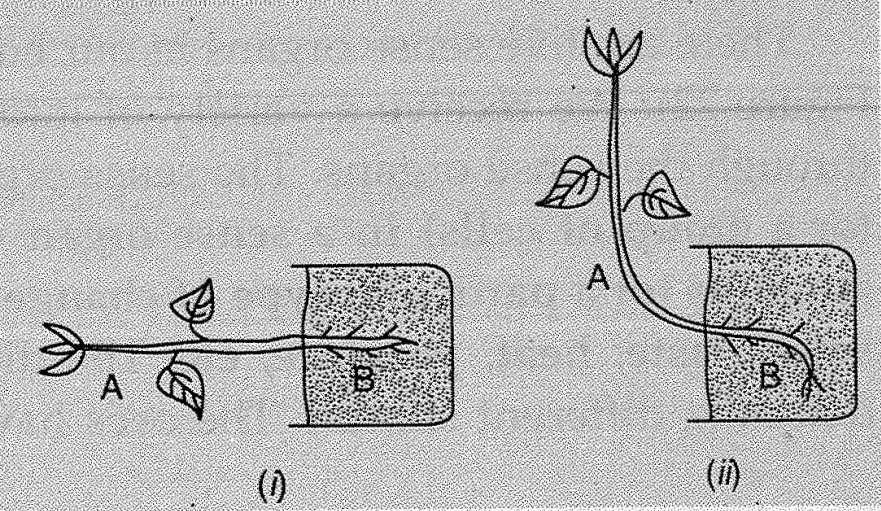
A potted plant having straight parts A and B was placed horizontally on its side as shown in figure (i). After a few days it was observed that the parts A and B of the plant acquire new positions as shown in Figure (ii).
  1. Name the phenomenon exhibited by the position of plant parts A and B in Figure (ii).
  2. Name the stimulus (other than sunlight) which causes plant part A to grow and bend upwards, and plant part B to bend downwards.
Choose the correct option from the bracket andexplain the statement giving reason:
Addition of an aqueous solution of $ZnSO_4$ to an aqueous solution of $BaCl_2$​​​​​​​ is an example of _________________ reaction.
(displacement, double displacement, decomposition)