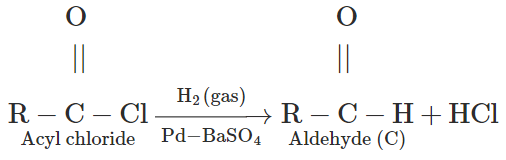
Question
Complete the following sequence of reactions and write structures for A, B, C.
Image

Answer

$\underset{\text { Alkyl magnesium halide }}{ R - Mg - X }+\underset{\text { dry ice }}{ C }= O \stackrel{\text { dry ether }}{\longrightarrow} R -\underset{\text { complex }}{ COOMgX } \underset{\text { dil } \cdot HCl }{\stackrel{ HOH }{\longrightarrow}} \underset{\text { Carboxylic acid (A) }}{ COOH }+ Mg ( X ) O H$

$\underset{\text { Carboxylic acid }}{ R - COOH }+ PCl _5 \stackrel{\Delta}{\rightarrow} \underset{\text { Acyl chloride }( B )}{ R - COCl + POCl _3+ HCl}$

Need a full question paper?

Generate a complete, print-ready paper with questions like this in minutes — across 16+ boards, with answer keys.

Start Generating Free

Similar questions

Explain the position of actinoids in the periodic table. What is the action of sulphur on lanthanoids? Calculate the magnetic moment of divalent ion in aqueous solution if its atomic number is $24.$
Discuss the trends in the following in case of groups 16,17 and 18 elements.
(1) Atomic and ionic radii
(2) Ionisation enthalpy
(3) Electronegativity
(4) Electron gain enthalpy
Give the structures of the following :
(1) Ethanol
(2) Propan-l-ol
(3) 2-Methylbutan-l-ol
(4) Pentan-3-ol
(5) Butan-2-ol
(6) 3-Methylbutan-2-ol
(7) Hexan-l-ol
(8) 3-Methylpentan-3-ol
(9) 2-Methylpropan-2-ol
(10) Butan-l-ol (H-Butyl alcohol)
(11) 2-Methylpropan-l-ol
(12) 2,3-Dimethylbutan-l-ol
(13) 2, 3-Dimethylbutan-2-oI
(14) 2-MethyIhexan-l-ol
(15) 2,2,3-Trimethylpentan-3-ol
(16) 2,3,3-Trimethylbutan-2-ol
(17) 3-EthyI-4-methylpentan-l-ol.

How will you prepare propan-l-amine from (1) butane nitrile (2) 1-nitropropane (3) propanamide (4) butanamide?
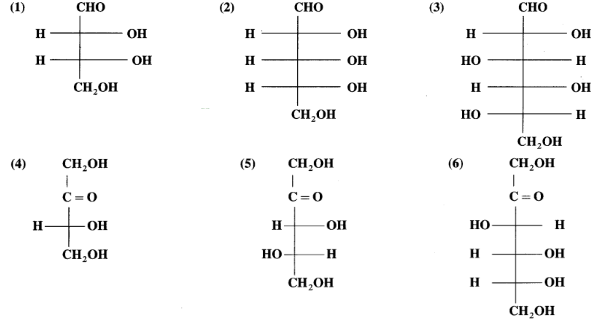
Assign D/L configuration to the following monosaccharides.

Image
Give the IUPAC names of the following amines :
What are isotonic solutions? Explain with one example.
Explain in detail the free radical mechanism involved during the preparation of the addition polymer.
Sketch qualitatively crystal field d orbital energy level diagrams for each of the following complexes :
$(a) [Ni(en)_3]^{2+} (b) [Mn(CN)_6]^{3-} (c) [Fe(H_2O)_6]^{2+}$
Predict whether each of the complexes is diamagnetic or paramagnetic.
Identify the strongest and the weakest reducing agents from the electrochemical series.