Question
Complete the following table:
Car Model
Driver X
Reaction time 0.20s
Driver Y
Reaction time 0.30s
A (deceleration on hard braking = 6.0m/s2)
Speed = 54km/h
Braking distance
a = ...
Total stopping distance
b = ...
Speed = 72km/h
Braking distance
c = ...
Total stopping distance
d = ...
B (deceleration on hard braking = 7.5m/s2)
Speed = 54km/h
Breaking distance
e = ...
Total stopping distance
f = ...
Speed 72km/h
Braking distance
g = ...
Total stopping distance
h = ...

Answer

Car Model
Driver X
Reaction time 0.25s
Driver Y
Reaction time 0.35s
A (deceleration on hard braking = 6.0m/s2)
Speed = 54km/h
Braking distance
a = 19m
Total stopping distance
b = 22m
Speed = 72km/h
Braking distance
c = 33m
Total stopping distance
d = 39m
B (deceleration on hard braking = 7.5m/s2)
Speed = 54km/h
Breaking distance
e = 15m
Total stopping distance
f = 18m
Speed 72km/h
Braking distance
g = 27m
Total stopping distance
h = 33m

$\text{a}=\frac{0^2-15^2}{2(-6)}=19\text{m}$

So, b = 0.2 × 15 + 19 = 33m

Similarly other can be calculated.

Braking distance: Distance travelled when brakes are applied.

Total stopping distance = Braking distance + distance travelled in reaction time.

Need a full question paper?

Generate a complete, print-ready paper with questions like this in minutes — across 16+ boards, with answer keys.

Start Generating Free

Similar questions

The magnetic field at a point, 10cm away from a magnetic dipole, is found to be 2.0 × 10⁻⁴ T. find the magnetic moment of the dipole if the point is.
  1. In end-on position of the dipole.
  2. In broadside-onposition of the dipole.
The photon picture of electromagnetic radiations and the characteristic properties of photons are as follows: ln the interaction ofradiation with matter, radiation behaves as ifit is made of particles like photons. 
Each photon has energy $\text{E}\Big(=\text{h}\upsilon=\frac{\text{hc}}{\lambda}\Big)$ and momentum $\text{p}\Big(=\frac{\text{h}\upsilon}{\text{c}}=\frac{\text{h}}{\lambda}\Big),$ where h is Planck's constant, $\upsilon$ and $\lambda$ are the frequency and wavelength of radiation and c is the velocity of light.
The photon energy is independent of the intensity of radiations.
All the photons emitted from a source of radiations travel through space with the same speed c. The frequency of photon gives the radiation, a definite energy (or colour) which does not change when photon travels through different media.
Photons are not deflected by electric and magnetic fields. This shows that photons are electrically neutral.
  1. Which one among the following shows particle nature of tight?
  1. Photoelectric effect
  2. Interference
  3. Refraction
  4. Polarization
  1. Which of the following statements about photon is incorrect?
  1. Photons exert no pressure.
  2. Momentum of photon is $\frac{\text{h}\upsilon}{\text{c}}$.
  3. Rest mass of photon is zero.
  4. Energy of photon is $\text{h}\upsilon$.
  1. The rest mass of photon is:
  1. $\frac{\text{h}\upsilon}{\text{c}}$
  2. $\frac{\text{h}\upsilon}{\text{c}^2}$
  3. $\frac{\text{h}\upsilon}{\lambda}$
  4. Zero
  1. ln a photon-particle collision (such as photon-electron collision), which of the following may not be conserved?
  1. Total energy.
  2. Number of photons.
  3. Total momentum.
  4. Both (a) and (b).
  1. 'n' photons of wavelength $'\lambda'$ are absorbed by a black body of mass 'm'. The momentum gained by the body is:
  1. $\frac{\text{h}}{\text{m}\lambda}$
  2. $\frac{\text{mnh}}{\lambda}$
  3. $\frac{\text{nh}}{\text{m}\lambda}$
  4. $\frac{\text{nh}}{\lambda}$
  1. A small compass needle of magnetic moment ‘m’ is free to turn about an axis perpendicular to the direction of uniform magnetic field ‘B’. The moment of inertia of the needle about the axis is ‘I’. The needle is slightly disturbed from its stable position and then released. Prove that it executes simple harmonic motion. Hence deduce the expression for its time period.
  2. A compass needle, free to turn in a vertical plane orients itself with its axis vertical at a certain place on the earth. Find out the values of (i) horizontal component of earth’s magnetic field and (ii) angle of dip at the place.
A silver ball of radius 4.8cm is suspended by a thread in a vacuum chamber. Ultraviolet light of wavelength 200 run is incident on the ball for some time during which a total light energy of 1.0 × 10⁻⁷J falls on the surface. Assuming that on the average one photon out of every ten thousand is able to eject a photoelectron, find the electric potential et the surface of the bell assuming zero potential at infinity. What is the potential at the centre of the bell?
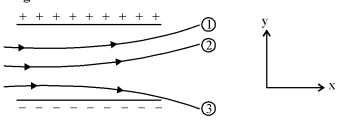
Figure shows track of three charged particles in a uniform elecrostatic field. Give the signs of the three charges. Which particle has the highest charge to mass ratio?
Image
The saturation current from a thoriated-tungsten cathode at 2000K is 100mA. What will be the saturation current for a pure-tungsten cathode of the same surface area operating at the same temperature? The constant A in the Richardson-Dushman equation is 60 × 104Am-2K-2 for pure tungsten and 3.0 × 10⁴Am-2k-2 for thoriated tungsten. The work function of pure tungsten is 4.5eV and that of thoriated tungsten is 2.6eV.
In the derivation of P1 - P2 = Pgz, it was assumed that the liquid is incompressible. Why will this equation not be strictly valid for a compressible liquid?
The distance between the centres of two insulated charged copper spheres ' $A$ ' and ' $B$ ' which are identical in size is 50 cm and the charge on each is $6.5 \times 10^{-7} C$. A third uncharged sphere ' C ' of the same size was first brought in contact with the sphere ' $A$ ', and then brought in contact with the second sphere ' $B$ ' and finally separated from both. Then find the magnitude of repulsive foce between ' $A$ ' and ' $B$ '.