Question
Complete the following table.
EquationNo. of variableswhether linear or not
$\frac{3}{x}-\frac{4}{y}=8$2Not linear
$\frac{6}{x-1}+\frac{3}{y-2}=0$
$\frac{7}{2 x+1}+\frac{13}{y+2}=0$
$\frac{14}{x+y}+\frac{3}{x-y}=5$

Answer

EquationNo. of variableswhether linear or not
$\frac{3}{x}-\frac{4}{y}=8$2Not linear
$\frac{6}{x-1}+\frac{3}{y-2}=0$2Not linear
$\frac{7}{2 x+1}+\frac{13}{y+2}=0$2Not linear
$\frac{14}{x+y}+\frac{3}{x-y}=5$2Not linear

Need a full question paper?

Generate a complete, print-ready paper with questions like this in minutes — across 16+ boards, with answer keys.

Start Generating Free

Similar questions

₹ 1000 is invested at 10 percent simple interest. Check at the end of every year if the total interest amount is in A.P. If this is an A.P. then find interest amount after 20 years. For this complete the following activity.
Simple interest $=\frac{ P \times R \times N }{100}$
Simple interest after 1 year $=\frac{1000 \times 10 \times 1}{100}=$⬜
Simple interest after 2 year$=\frac{1000 \times 10 \times 2}{100}=$ ⬜
Simple interest after 3 year$=\frac{\square \times \square \times \square}{100}=300$
According to this the simple interest for 4, 5, 6 years will be 400,⬜,⬜ respectively.
From this d= ⬜ and a=⬜
Amount of simple interest after 20 years
tn + a + (n – 1) d
t20=⬜+(20-1)⬜
t20=⬜
Amount of simple interest after 20 years is = ⬜
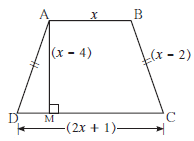
In the adjoining fig. ⬜ABCD is a trapezium AB||CD and its area is 33 cm2. From the information given in the figure find the lengths of all sides of the ⬜ABCD. Fill in the empty boxes to get the solution.
Image

⬜ $\square ABCD$ is a trapezium. $AB \| CD$
Area of trapezium
$=\frac{1}{2} \times($ Sum of parallel sides $) \times$ Height
$\therefore \quad A (⬜ABCD )=\frac{1}{2} \times( AB + CD ) \times$⬜
$\therefore \quad 33=\frac{1}{2}(x+2 x+1) \times$⬜
∴ ⬜$=(3 x+1) \times$ ⬜
$\therefore \quad 66=3 x^2-12 x+x-4$
$\therefore \quad 3 x^2$ - ⬜ - ⬜ = 0
$\therefore \quad 3 x^2-21 x+10 x-70=0$
$\therefore \quad 3 x(x-7)+10(x-7)=0$
$\therefore \quad(3 x+10)(x-7)=0$
By using the property, if the product of two numbers is zero, then at least one of them is zero, we get
$\therefore \quad(3 x+10)=0$ or ⬜ = 0
$\therefore \quad x=\frac{-10}{3}$ or $x=$ ⬜
But, length is never nagative.
∴ $x \neq \frac{-10}{3}$
∴ x = ⬜
AB = ⬜
CD = ⬜
AD = BC = ⬜
A frequency distribution of funds collected by 120 workers in a company for the drought affected people are given in the following table. Find the mean of the funds by 'step deviation' method.
Fund (Rupees)0-500500-10001000-15001500-20002000-2500
No. of workers3528321510
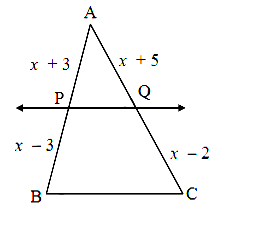
From fig., seg $PQ ||$ side $BC, AP = x + 3, PB = x – 3, AQ = x + 5, QC = x – 2,$ then complete the activity to find the value of $x.$

$\text { In } \triangle P Q B, P Q|| \text { side } B C$
$\frac{ AP }{ PB }=\frac{ AQ }{[} \quad \ldots[\ldots]$
$\frac{x+3}{x-3}=\frac{x+5}{[}$
$(x+3)[\quad]=(x+5)(x-3)$
$x^2+x-[\quad]=x^2+2 x-15$
$x=[$
Decide which of the following are quadratic equations ?
1. 3x² - 5x + 3 = 0
2. 9y² + 5= 0
3. m³ - 5m² + 4 = 0
4. (l + 2) (l - 5) = 0
Solution :
1.In the equation 3x2 - 5x + 3 = 0, x is the only variable and maximum
index of the variable is 2
It is a quadratic equation.
2. In the equation 9y2 + 5= 0, ⬜ is the only variable and maximum index of the variable is⬜
it ⬜ a quadratic equation.
3.In the equation m3 - 5m2+ 4 = 0,⬜ is the only variable but maximum index of the variable is not 2.
It ⬜ quadratic equation.
4.(l + 2) (l - 5) = 0
l (l - 5) + 2 (l - 5) = 0
l2 - 5l + 2l - 10 = 0
l2 - 3l - 10 = 0, In this equation.⬜ is the only variable and maximum index of the variable is⬜
it ⬜ a quadratic equation.
To prove $\cot \theta+\tan \theta=\operatorname{cosec} \theta \times \sec \theta$, complete the activity given below.
Activity:
L.H.S = $\square$
$ =\frac{\square}{\sin \theta}+\frac{\sin \theta}{\cos \theta}$
$=\frac{\cos ^2 \theta+\sin ^2 \theta}{\square}$
$=\frac{1}{\sin \theta \cdot \cos \theta} \quad \ldots \ldots . .\left[\cos ^2 \theta+\sin ^2 \theta=\square\right]$
$=\frac{1}{\sin \theta} \times \frac{1}{\square}$
$=\square$
$=\text { R.H.S } $
Do the following activity to draw tangents to the circle without using the center of the circle.
  1. Draw a circle with radius 3.5 cm and take any point C on it.
  2. Draw chord CB and an inscribed angle CAB.
  3. With the center A and any convenient radius, draw an arc intersecting the sides of angle BAC in points M and N.
  4. Using the same radius, draw an arc intersecting the chord CB at point R.
  5. Taking the radius equal to d(MN) and center R, draw an arc intersecting the arc drawn in the previous step. Let D be the point of intersection of these arcs. Draw line CD. Line CD is the required tangent to the circle.
A frequency distribution table for the production of oranges of some farm owners is given below. Find the mean production of oranges by 'assumed mean' method.
Production
(Thousand rupees)
25-3030-3535-4040-4545-50
No. of farm owners2025151010
The following frequency distribution table gives the ages of 200 patients treated in a hospital in a week. Find the mode of ages of the patients.