Question
Complete the paragraph by choosing the right options given below.
(minimum, near point, 25 cm, farthest, farthest distance, far point)
The _______ distance of an object from a normal eye, at which it is clearly visible without stress on the eye, is called the minimum distance of distinct vision. The position of the object at this distance is called the _______ of the eye, for a normal human eye, the near point is at _______. The _______ distance of an object from a human eye, at which it is clearly visible without stress on the eye is called _______ of distinct vision. The position of the object at this distance is called the _______ of the eye.
Answer

The minimum distance of an object from a normal eye, at which it is clearly visible without stress on the eye, is called the minimum distance of distinct vision. The position of the object at this distance is called the near point of the eye, for a normal human eye, the near point is at 25 cm. The farthest distance of an object from a human eye, at which it is clearly visible without stress on the eye is called farthest distance of distinct vision. The position of the object at this distance is called the far point of the eye.

Need a full question paper?

Generate a complete, print-ready paper with questions like this in minutes — across 16+ boards, with answer keys.

Start Generating Free

Similar questions

Explain the similarity and difference in two events, namely adding NaOH to water and adding CaO to water.
Draw a neat labelled diagram.Schematic of nuclear power plant.
When a copper coin is dipped in silver nitrate solution, a glitter appears on the coin after some time. Why does this happen? Write the chemical equation.
Three appliances are connected in parallel to the same source which provides a voltage of 220V. A fuse connected to the source will blow if the current from the source exceeds 10A. If the three appliances are rated at 60W, 500W and 1200W at 220V, will the fuse blow?
How are concave and convex mirrors constructed?
Two resistances when connected in parallel give resultant value of $2$ ohm; when connected in series the value becomes $9$ ohm. Calculate the value of each resistance.
An element X from group 2 of the periodic table reacts with an element Y from group 17 to form a compound.
  1. What is the nature of the compound formed?
  2. State whether the compound formed will conduct electricity or not.
  3. Give the formula of the compound formed.
  4. What is the valency of element X?
  5. How many electrons are there in the outermost shell of an atom of element Y?
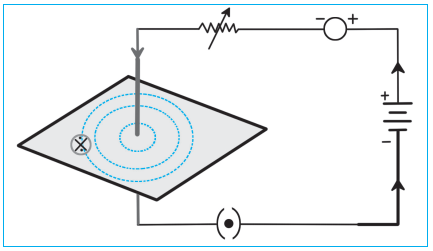
Take a battery, (12V) a variable resistance (or a rheostat), an ammeter (0_5 A), a plug key, needle and a long straight thick copper wire. Take a rectangular cardboard, pass this wire through center. Fix the cardboard and see that it does not slide up or down. Sprinkle iron filings uniformly on the cardboard. Close the key and tap the cardboard gently.
Image
(i) Observe the pattern of iron filings.
(ii) What changes are seen in the magnetic field lines?
(iii) What happens to the magnetic needle of the compass when the compass is brought near the wire, and moved away from the wire? Also observe what happens to the magnetic needle when strength of current is increased.
(iv) What happens to the magnetic needle of the compass when direction of the current is reversed in the straight conductor? State the reasons for your observation.
What are the various types of heterotrophic nutrition?
Classify the following compounds as alkanes, alkenes and alkynes:
$C_2H_{4,}C_3H_{4,}C_4H_{8,}C_5H_{12,}C_5H_{8,}C_3H_{8,}C_6H_6$