MCQ
Complete the reaction $\mathrm{n}+{ }_{92}^{235} \mathrm{U} \rightarrow{ }_{56}^{144} \mathrm{Ba}+\cdots+3 \mathrm{n}$
  • ${ }_{36}^{89} \mathrm{Kr}$
  • B
    ${ }_{36}^{90} \mathrm{Kr}$
  • C
    ${ }_{36}^{91} \mathrm{Kr}$
  • D
    ${ }_{36}^{92} \mathrm{Kr}$

Answer

Correct option: A.
${ }_{36}^{89} \mathrm{Kr}$

Need a full question paper?

Generate a complete, print-ready paper with questions like this in minutes — across 16+ boards, with answer keys.
Start Generating Free

Similar questions

Joining of light nuclei of elements to form a heavy nucleus with the release of energy is called:
Two rods of same material and length have their electric resistance in ratio 1 : 2. When both rods are dipped in water, the correct statement will be(a) A has more loss of weight(b) B has more loss of weight(c) Both have same loss of weight(d) Loss of weight will be in the ratio 1 : 2
   
   
$10^{-3} \ \text{amp}$ is flowing through a resistance of $1000 \Omega$. To measure the correct potential difference, the voltmeter is to be used of which the resistance should be
The velocity of photon is proportional to $($where $v$ is frequency$)$
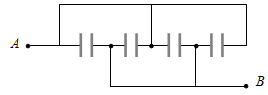
Four condensers are joined as shown in the adjoining figure. The capacity of each is $8 \mu F$. The equivalent capacity between the points $A$ and $B$ will be
The temperature $(T)$ dependence of resistivity $(r)$ of a semiconductor is represented by
If in a nuclear fusion process the masses of the fusing nuclei be $\mathrm{m}_1$ and $\mathrm{m}_2$  and the mass of the resultant nucleus be $\mathrm{m}_3$, then
If the binding energy of the electron in a hydrogen atom is $13.6\ eV,$ the energy required to remove the electron from the first excited state of $Li^{++}$ is
Two small spheres each carrying a charge q are placed r metre apart. If one of the spheres is taken around the other one in a circular path of radius r, the work done will be equal to(a) Force between them × r (b) Force between them × 2πr (c) Force between them /2πr (d) Zero
   
   
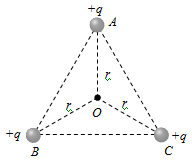
$\text{ABC}$ is an equilateral triangle. Charges $+ q$ are placed at each corner. The electric intensity at $O$ will be