Question
Complete the reactions:
  1. $ \text{H}_2+\text{CO}+\text{R}-\text{CH}=\text{CH}_2\xrightarrow{\ \ \ \ \ }$
  2. $\text{H}_2+\text{RCH}_2\text{CH}_2\text{CHO}\xrightarrow{\ \ \ \ \ }$
Answer

  1. $\text{H}_2+\text{CO}+\text{R}-\text{CH}=\text{CH}_2\\\ \ \ \ \ \ \ \ \ \ \ \ \ \ \ \ \ \ \ \ \ \ \ \ \ \ \ \ \ \ \ \ \ \ \ \ \ \ \ \ \text{O}\\\\ \ \ \ \ \ \ \ \ \ \ \ \ \ \ \ \ \ \ \ \ \ \ \ \ \ \ \ \ \ \ \ \ \ \ \ \ \ \ \ \ \| \\ \xrightarrow{\ \ \ \ \ }\text{R}-\text{CH}_2-\text{CH}_2-\text{C}-\text{H}$
  2. $\text{H}_2+\text{RCH}_2\text{CH}_2\text{CHO}\xrightarrow{\ \ \ \ \ \ \ }\text{RCH}_2\text{CH}_2\text{CH}_2\text{OH}$

Need a full question paper?

Generate a complete, print-ready paper with questions like this in minutes — across 16+ boards, with answer keys.

Start Generating Free

Similar questions

How many possible carboxylic acid isomers of molecular formula $C _5 H _{10} O _2$ exist?
Write the electronic configuration of ${ }_9 \mathrm{~F}^{19},{ }_{16} \mathrm{~S}^{32}$ and ${ }_{18} \mathrm{Ar}^{38}$ and then point out the element with:
  1. Maximum nuclear charge.
  2. Minimum number of neutrons.
  3. Maximum number of unpaired electrons.
Why are dipole moments of $\text{CO}_2,\text{BF}_3,\text{CCl}_4,\text{PF}_5,\text{SF}_6$ are zero?
Arrange the following compounds in decreasing order of property indicated against each. Give reason for your answer: $\mathrm{BCl}_3, \mathrm{AlCl}_3, \mathrm{AgCl}_3, \mathrm{InCl}_3, \mathrm{TICl}_3$
(Stability of +3 oxidation state.)
The $\text{H}-\text{S}-\text{H}$ bond angle in $\mathrm{H}_2 \mathrm{S}$ is 92.2° whereas the $\text{H}-\text{O}-\text{H}$ bond angle in $\mathrm{H}_2 \mathrm{O}$ is 104.5°, why?
Calculate: Mass of 2.5 gram atoms of magnesium,
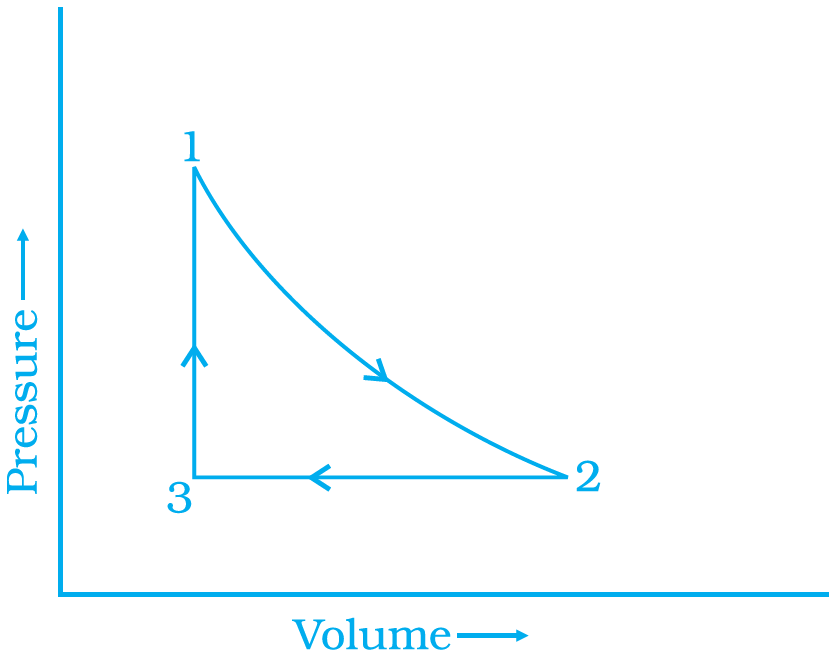
A sample of 1.0mol of a monoatomic ideal gas is taken through a cyclic process of expansion and compression as shown in Fig. What will be the value of $\Delta\text{H}$ for the cycle as a whole?
At 0°C, ice and water are in equilibrium and $\Delta\text{H}=6.06\text{kJ mol}^{-1}$ for the process, $\mathrm{H}_2 \mathrm{O}(\mathrm{s}) \rightarrow \mathrm{H}_2 \mathrm{O}(\mathrm{l})$
What will be $\Delta\text{S}$ and $\Delta\text{G}$ for the conversion of ice into liquid water?
Write a short note on hydrogenation of unsaturated aliphatic hydrocarbons.
One millilitre solution of 0.01M HCl is added to 1L of sodium chloride solution. What will be the pH of the resulting solutions?