Question
Compromise and accommodation are the two essential policies required by states to save planet Earth. Substantiate the statement in the light of the ongoing negotiations between the North and South on environmental issues.

Answer

Compromise and accommodation are the two essential policies to save Planet Earth by the states but the states from North and South have different notions towards environmental issues.It was obvious at the Rio Summit that the rich and developed countries of the First World, generally referred to as the ‘global North’ were pursuing a different environmental agenda than the poor and developing countries of the Third World, called the ‘global South’.
Whereas the Northern states were concerned with ozone depletion and global warming, the Southern states were anxious to address the relationship between economic development and environmental management.
The developed countries of the North want to discuss the environmental issues which stand equally responsible for ecological conservation. The developing countries of the south feel that much of the, ecological degradation in the world is created by developed countries through their industrial projects. And if developed countries cause more environmental degradation they are supposed to take more responsibility onwards.
The developing counties are under process of industrialization and they should be exempted from restrictions imposed on developed countries through various conventions like protocol etc. The special needs of developing countries must be taken into considerations in the process of development, application and interpretation of rules of International Environmental Law.
All the above mentioned provisions were accepted in Earth Summit, 1992 while adopting common but differentiated responsibilities.
Need a full question paper?

Generate a complete, print-ready paper with questions like this in minutes — across 16+ boards, with answer keys.

Start Generating Free

Similar questions


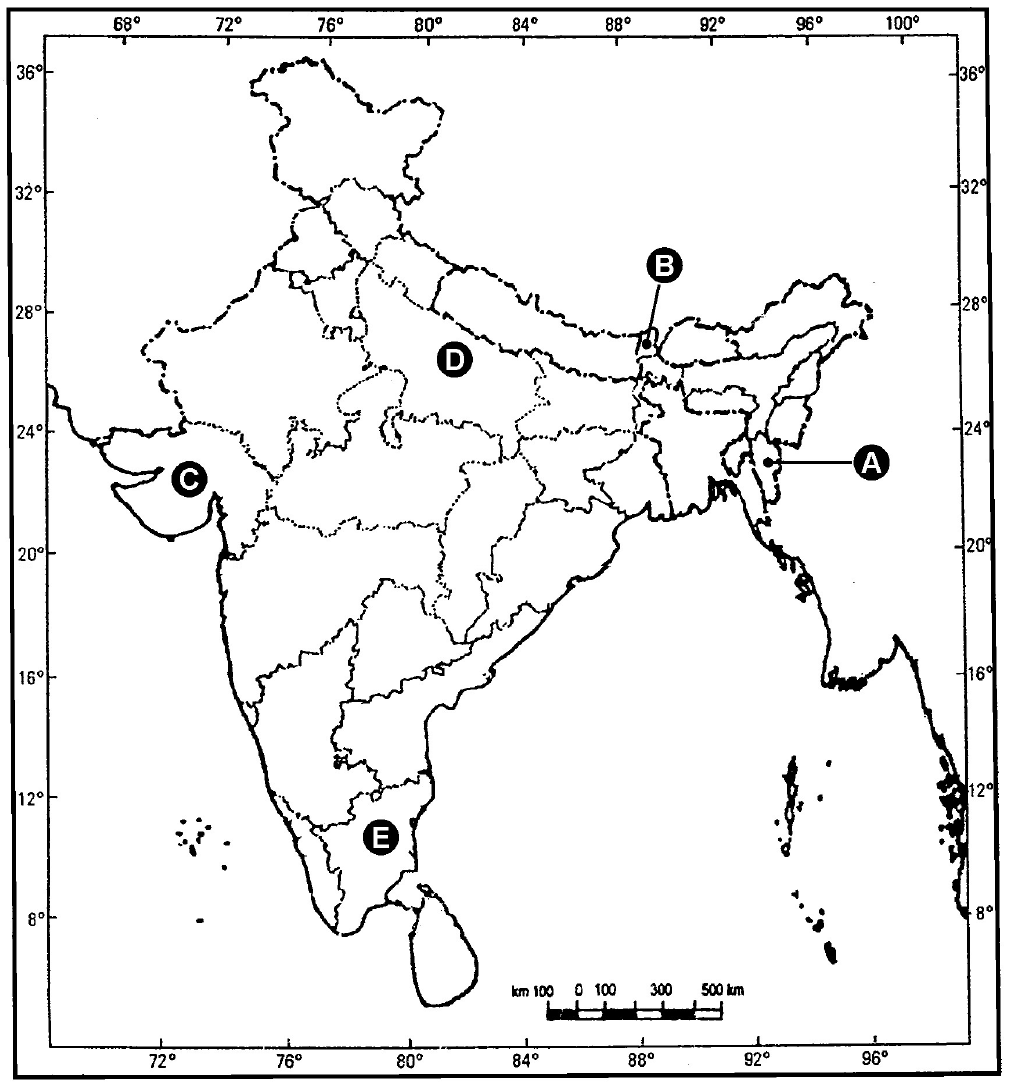
In the political outline map of India given above, five states have been marked as A, B, C, D and E. Identify these states on the basis of information given below and write their correct names in your answer book along with the respective serial number of the information used and the concerned alphabet in the map as per the following format.
Sr. No. of the information used
Concerned alphabet in the Map
Name of the State
i.
 
 
ii.
 
 
iii.
 
 
iv.
 
 
v.
 
 
  1. The state where a violent incident took place at Godhara in $2002$.
  2. The state which was earlier known as Madras.
  3. The state which has the maximum number of seats in India in its Legislative Assembly.
  4. The state to which Laldenga belonged.
  5. The state which integrated with India in $1975$ as $22^{nd}$ State of India.
Analyse India’s stand on any three environmental issues.
Analyse India‘s stand on environmental issues.
Describe any six criteria for the new membership of Security Council as suggested after 1997.
Why is globalisation being criticised strongly all over the world? Explain any four reasons.
Analyse any four factors responsible for the downfall of the Janata Government in 1979.
Why do some countries question India’s inclusion as a permanent member of the U.N. Security Council? Explain.
State the main issues in Indian politics in the period after 1989. What different configurations of political parties these differences lead to?
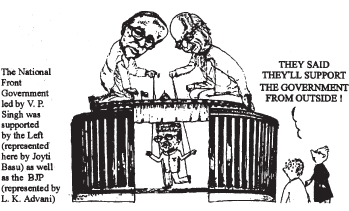
Look at the cartoon carefully and answer the following questions:
  1. Does the cartoon refer to a puppet govt.?
  2. Describe the role of such a government in the Indian democratic set up.
  3. What is meant by ‘support from outside’?
Trace the evolution of the United Nations since is establishment in 1945. How does it function with the help of its structures and agencies?