Question
Compton effect shows that(a) X-rays are waves(b) X-rays have high energy(c) X-rays can penetrate matter(d) Photons have momentum


Answer

(d) Photons have momentum

Need a full question paper?

Generate a complete, print-ready paper with questions like this in minutes — across 16+ boards, with answer keys.
Start Generating Free

Similar questions

A short bar magnet placed with its axis at 30° with a uniform external magnetic field of 0.16 Tesla experiences a torque of magnitude 0.032 Joule. The magnetic moment of the bar magnet will be(a) 0.23 Joule/Tesla(b) 0.40 Joule/Tesla(c) 0.80Joule/Tesla(d) Zero
       
When the convergent nature of a convex lens will be less as compared with air(a) In water (b) In oil(c) In both (a) and (b) (d) None of these
       
A closed cubical box is completely filled with water and is accelerated horizontally towards right with an acceleration α. The resultant normal force by the water on the top of the box.
  1. Passes through the centre of the top.
  2. Passes through a point to the right of the centre.
  3. Passes through a point to the left of the centre.
  4. Pecomes zeros.
If two bodies A and B (A bigger in size than B) are rubbed together, then:
The electric potential at a point on the axis of an electric dipole depends on the distance $r$ of the point from the dipole as
10 C charge is passing through any point in electric circuit in 0.5 second. The magnitude of electric current in the circuit in amperes is:
The length of a solenoid is $0.4m$ and the number turns in it is $500$. A current of $3\ amp$, is flowing in it. In a small coil of radius $0.01m$ and number of turns $10$, a current of $0.4\ amp$. is flowing. The torque necessary to keep the axis of this coil perpendicular to the axis of solenoid will be:
A vertical straight conductor carries a current vertically upwards. A point P lies to the east of it at a small distance and another point Q lies to the west at the same distance the magnetic field at P is:
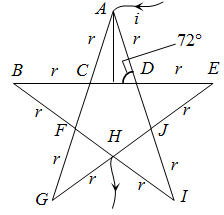
In the following star circuit diagram $($figure$),$ the equivalent resistance between the points $A$ and $H$ will be
Focal length of a convex lens will be maximum for(a) Blue light(b) Yellow light(c) Green light(d) Red light