Question
Computerised accounting system is the best form of accounting system. Do you agree? Comment.

Answer

Yes, Computerised accounting system is the best form of accounting system Advantages of Computerised Accounting System:
  1. High Speed: The accounting speed of a computer is much faster than that of a human being.
  2. High Reliability: The extent of reliability of the information generated by a computer is immense. The reliability remains the same despite the volume of the work whereas the reliability of a human work can be doubtful in case of voluminous work.
  3. Accuracy: The accuracy of a computer cannot be doubted once a particular program is fed. All the results based on such program would be 100% accurate whereas the results produced by a human being can vary due to fatigue, carelessness, etc.
  4. Updation of Information: All the related records in a computer get automatically updated once any information is punched in, whereas in case of manual accounts all the records will have to be altered one by one.
  5. Efficiency: The computer based accounting systems ensure better and efficient use of resources and time.
  6. Legibility: The data displayed on a computer screen is clear and legible thus avoiding errors caused by untidy writing in a manual accounting system.
  7. Lower Cost: The cost of maintaining accounts under the computerised system is much lower as compared to the manual system.

Need a full question paper?

Generate a complete, print-ready paper with questions like this in minutes — across 16+ boards, with answer keys.
Start Generating Free

Similar questions

Ashok keeps incomplete records. The position of his business on $1^{st}$ April, $2016$ was as follows: Cash in Hand ₹ $2,200$; Cash at Bank ₹ $5,400$; Stock ₹ $25,100$; Sundry Debtors ₹ $18,700$; Furniture ₹ $6,000$; Sundry Creditors ₹ $13,500$. His position on $31^{st}$ March, $2017$ was as follows: Cash in Hand ₹ 1,500; Cash at Bank ₹ $8,400$; B/R ₹ $3,300$; Stock ₹ $26,000$; Sundry Debtors ₹ $24,600$; Furniture ₹ $8,000$; Sundry Creditors ₹ $14,200$. During the year he had withdrawn from the business ₹ $18,000$, of which ₹ $9,200$ were spent in purchasing a Typewriter for the business.
  1. Depreciate furniture and typewriter by $10\%$.
  2. Write off ₹ $600$ as Bad-Debts.
  3. Make a provision of $5\%$ on Debtors for doubtful debts.
Calculate the profit or loss of his business for the year ended $31^{st}$ March, $2017$ and prepare a final statement of affairs, after the above adjustments.
From the following information prepare trading and profit and loss account of M/s Indian sports house for the year ending March 31, 2017. Adjustments:
  1. Closing stock was 45,000.
  2. Provision for doubtful debts is to be maintained @ 2% on debtors.
  3. Depreciation charged on : furniture and fixture @ 5%, plant and Machinery @ 6% and motor car @ 10%.
  4. A Machine of 30,000 was purchased on October 01, 2016.
  5. The manager is entitle to a commission of @ 10% of the net profit after charging such commission.
From the following prepare Single Column Cash Book of Suresh, Chennai and post them into ledger accounts:
2019  
April 1 Cash in Hand 6,400
April 3 Received Cash from Anupama 1,00,000
April 4 Paid into Bank 80,000
April 5 Received from Bhumika as commission ₹ 6,000 plus CGST and SGST @ 6% each  
April 6 Paid Wages 30,000
April 7 Withdrawn from Bank for expenses 30,000
April 8 Purchased goods from Ashok on credit of ₹ 10,000 plus CGST and SGST @ 6% each  
April 9 Cash sales of ₹ 10,000 charged CGST and SGST @ 6% each  
April 11 Drew Cash for domestic purposes 10,000
April 12 Purchased furniture for ₹ 4,000 plus CGST and SGST @ 6% each  
April 13 Paid to Ruma 1,200
April 14 Paid to Ganguly Brothers for office fan ₹ 1,500 plus CGST and SGST @ 6% each  
April 15 Paid own life insurance premium from office cash 800
April 16 Purchased stationery ₹ 1,000 plus CGST and SGST @ 6% each  
April 17
Paid office expenses
500
April 18
Remitted to Raman
900
April 19
Paid electricity charges
100
April 20
Received interest from Gupta & Co.
500
April 30
Deposited all cash into bank in excess of
2,000
Prepare the trading and profit and loss account and balance sheet of M/s ontrol Device India on March 31, 2017 from the following balance as on that date.
Closing stock was valued ₹ 20,000.
  1. Interest on capital @ 10%.
  2. Interest on drawings @ 5%.
  3. Wages outstanding ₹ 50.
  4. Outstanding salary ₹ 20.
  5. Provide a depreciation @ 5% on plant and machinery.
  6. Make a 5% provision on debtors.
What do you understand by database. How does it differ from DBMS?
On 1st July, 2015, A Co. Ltd. purchases second-hand machinery for ₹ 20,000 and spends ₹ 3,000 on reconditioning and installing it. On 1st January, 2016, the firm purchases new machinery worth ₹ 12,000. On 30th June, 2017, the machinery purchased on 1st January, 2016, was sold for ₹ 8,000 and on 1st July, 2017, a fresh plant was installed.
Payments for this plant was to be made as follows:
1st July, 2017
₹ 5,000
30th June, 2018
₹ 6,000
30th June, 2019
₹ 5,500
Payments in 2018 and 2019 include interest of ₹ 1,000 and ₹ 500 respectively.
The company writes off 10% p.a. on the original cost. The accounts are closed every year on 31st March. Show the Machinery Account for the year ended 31st March, 2018.
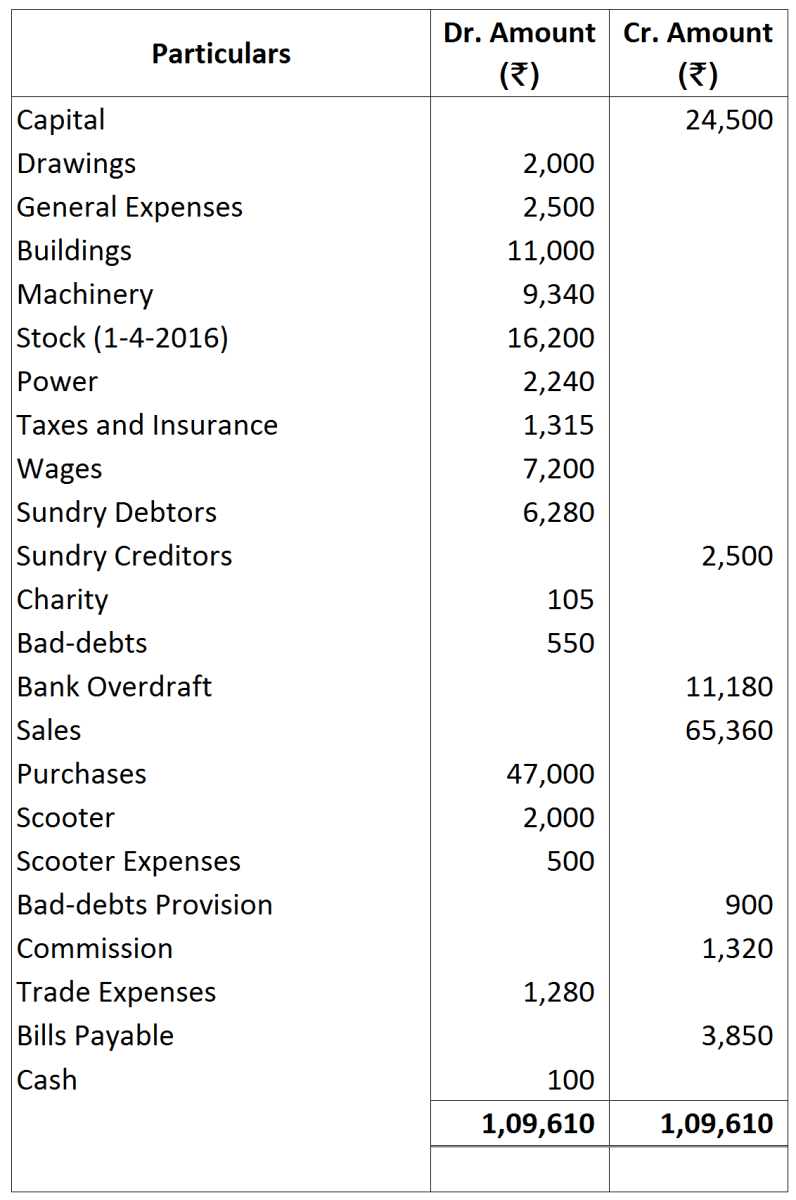
The following balances were extracted from the books of Shri Krishan Kumar as at 31st March, 2017:

Adjustments:
  1. Stock on 31st March, 2017 was valued at ₹ 23,500.
  2. $\frac{1}{5}\text{th}$ of general expenses and taxes & insurance to be charged to factory and the balance to the office.
  3. Write off a further Bad-debts of ₹ 160 and maintain the provision for Bad-debts at 5% on Debtors.
  4. Depreciate Machinery at 10% and Scooter by ₹ 240.
  5. Provide ₹ 700 for outstanding interest on Bank Overdraft.
  6. Prepaid Insurance is to the extent of ₹ 50.
  7. Provide for Manager's Commission at 10% on the Net Profit after charging such Commission.
Prepare final accounts for the year ended 31st March, 2017 after giving effect to the above adjustments.
What are the salient features in Tally?
Vinod sold goods to Darbara Singh for ₹ 1,000 on 1st January, 2019. He drew on the latter a bill for the amount payable 3 months after date. He discounted the bill with his bank for ₹ 990 on 4th January, 2019. On maturity, the bill is duly met. Make the Journal entries in the books of Vinod and Darbara Singh.
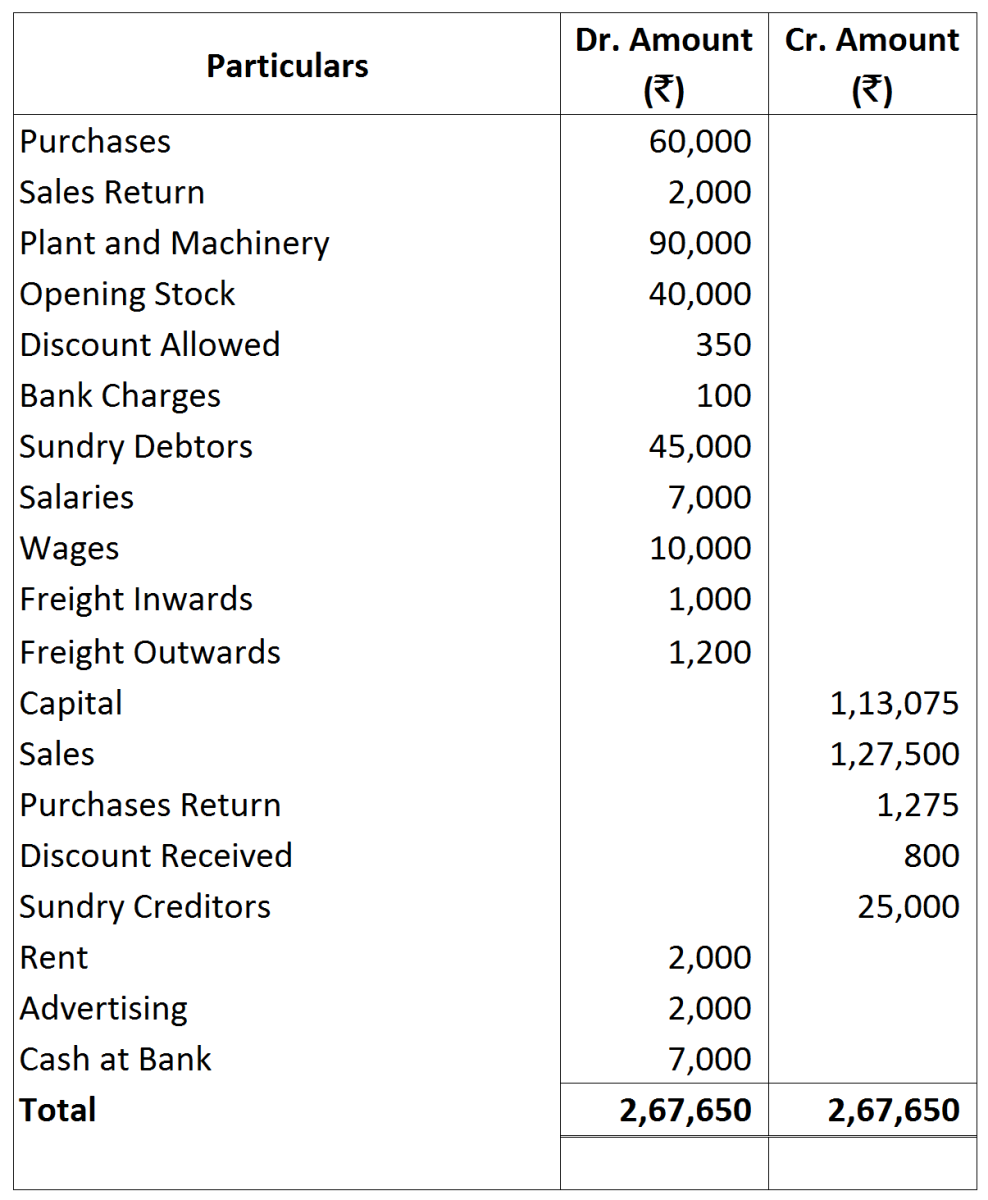
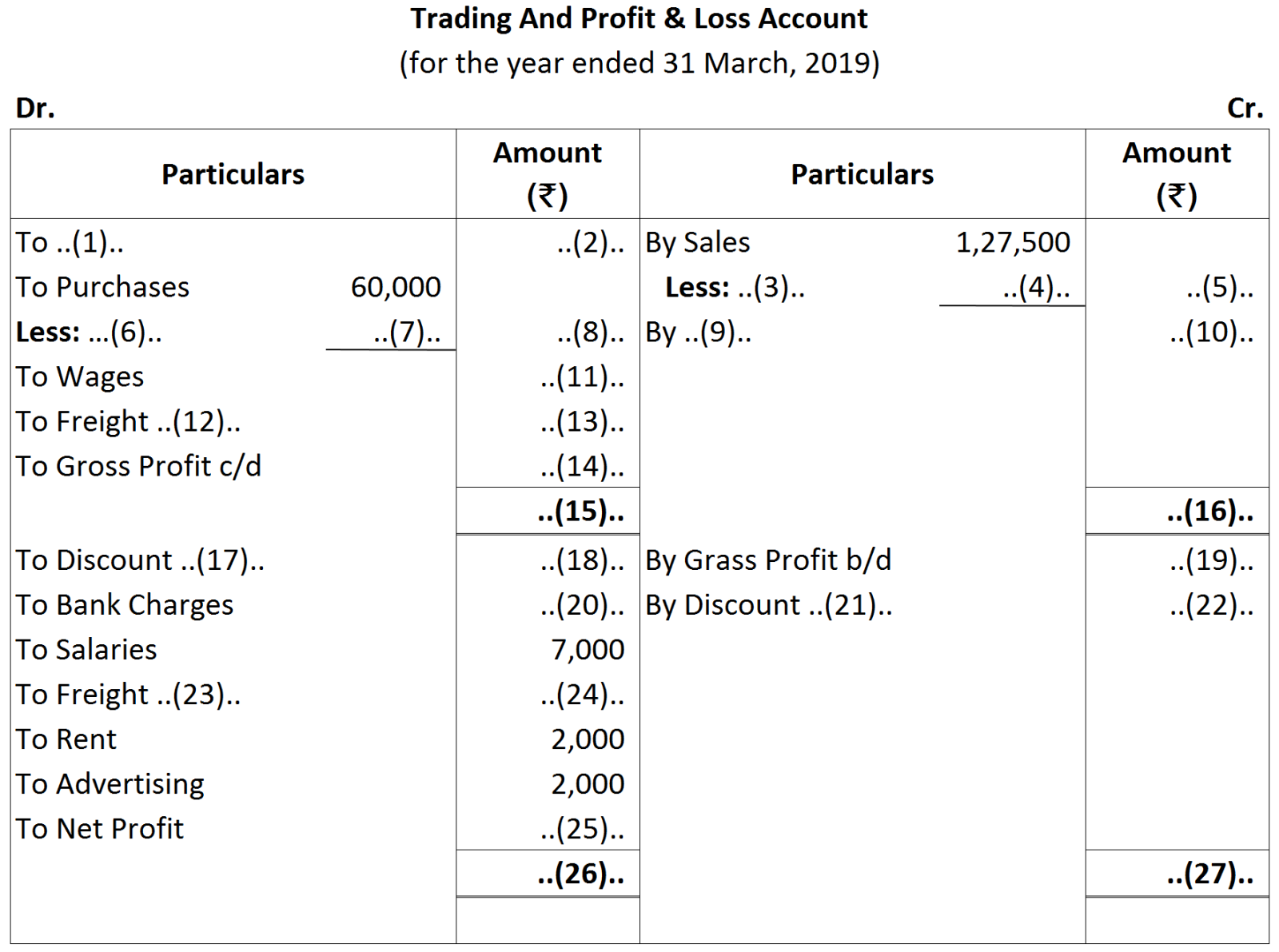
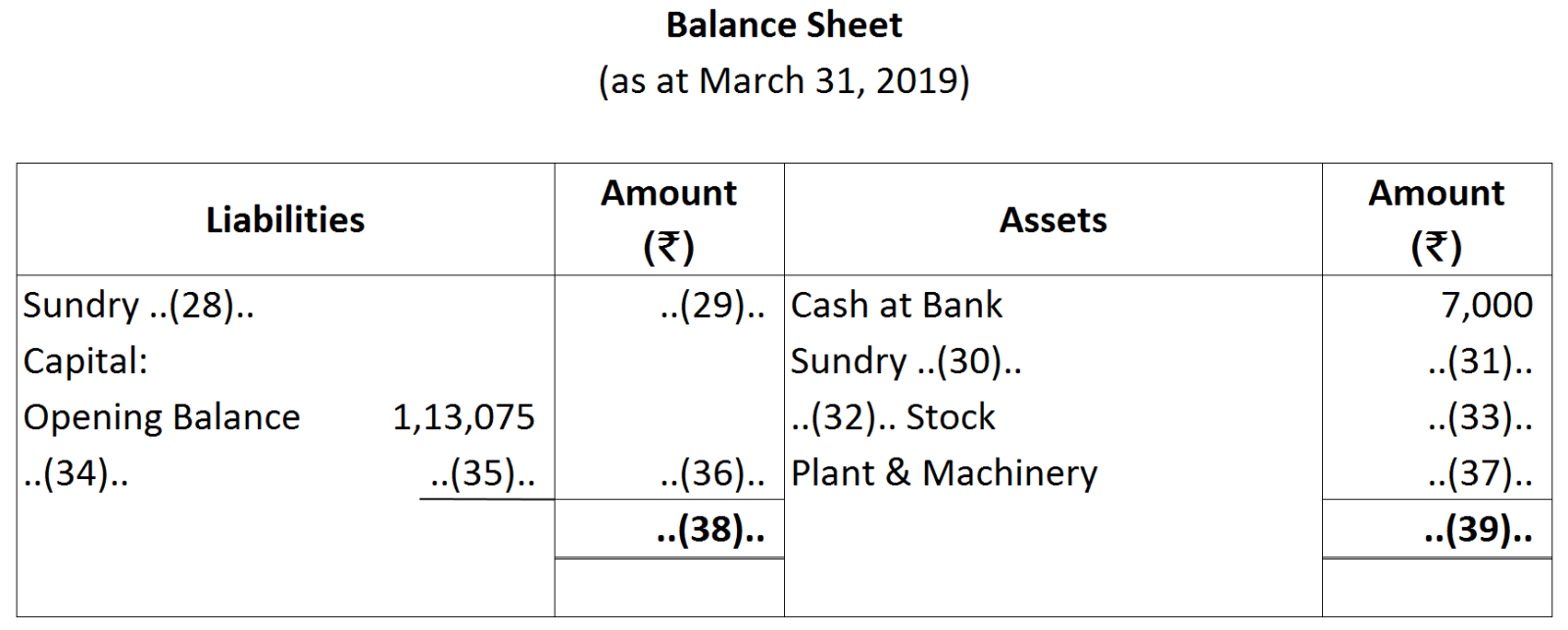
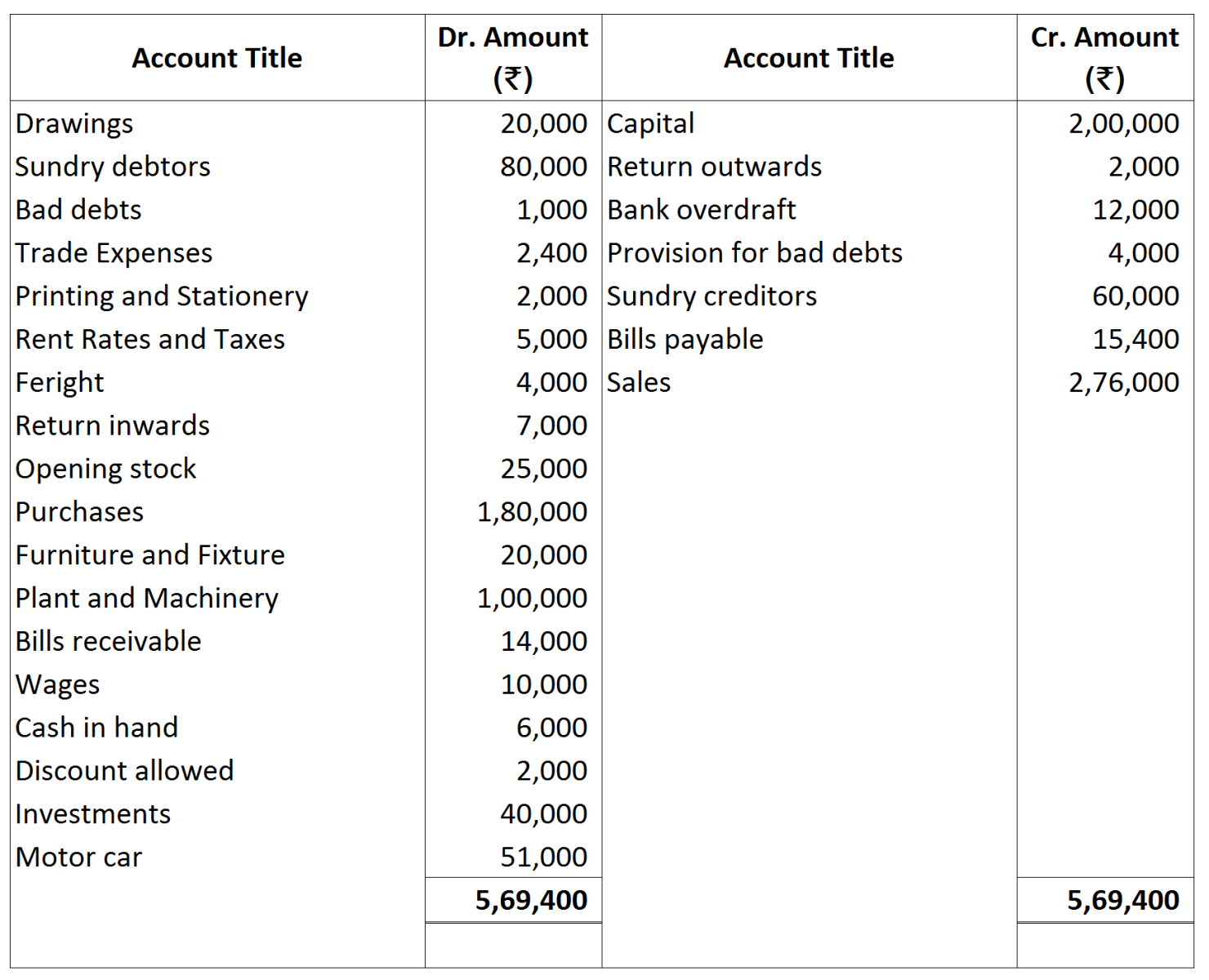
The Trial Balance shows the following balance as at $31^{st}$ March, $2019$:

Closing Stock was valued at ₹ $35,000$.
Required: Complete the missing values of Trading Account, Profit and Loss Account and Balance Sheet.