MCQ
Conc. ${H_2}S{O_4}$ is diluted
- ABy adding water in ${H_2}S{O_4}$
- ✓By adding ${H_2}S{O_4}$ in water
- CBy adding glacial acetic acid in ${H_2}S{O_4}$
- DNone of the above
Generate a complete, print-ready paper with questions like this in minutes — across 16+ boards, with answer keys.
Given that :
$F{e^{2 + }} + 2{e^ - } \to Fe;$ ${E^o}_{F{e^{2 + }}/Fe} = - 0.47\,V$
$F{e^{3 + }} + {e^ - } \to F{e^{2 + }};$ ${E^o}_{F{e^{3 + }}/F{e^{2 + }}} = + 0.77\,V$
Assertion $A :$ Dipole-dipole interactions are the only non-covalent interactions, resulting in hydrogen bond formation.
Reason $R$ : Fluorine is the most electronegative element and hydrogen bonds in $HF$ are symmetrical.
In the light of the above statements, choose the most appropriate answer from the options given below.
Reason : Energy of the activated complex is higher than the energy of reactant molecules.
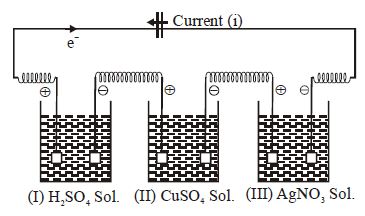
A current was passed for $10$ hours. $10.8\ g Ag$ was deposited at cathode in $(III)$ electrolytic cell during electrolysis if current efficiency is $50\%.$
If $Z_1,$ $Z_2$ and $Z_3$ be the electrochemical equivalent in the formation of $H_2, Cu$ and $Ag$ respectively, hence $Z_1 : Z_2 : Z_3$ would be