MCQ
Conc. $HN{O_3}$
  • A
    Reacts with aluminium vigrously
  • B
    Reacts with aluminium to form aluminium nitrate
  • Does not react with aluminium
  • D
    Reacts with platinum

Answer

Correct option: C.
Does not react with aluminium
c
Aluminum metal is not attacked by nitric acid of any concentration because of the thin and unreactive protective layer of aluminum oxide formed on the metallic surface due to the reaction of aluminium metal with oxygen of air.

Need a full question paper?

Generate a complete, print-ready paper with questions like this in minutes — across 16+ boards, with answer keys.

Start Generating Free

Similar questions

in the reaction , $C{H_3}C \equiv C - C{H_3}\xrightarrow[{(ii)Zn/{H_2}O}]{{(i)X}}\begin{array}{*{20}{c}}
  {C{H_3} - C - C - C{H_3}} \\ 
  {||\,\,\,\,\,\,\,\,\,||} \\ 
  {O\,\,\,\,\,\,\,O} 
\end{array} ,X$ is
Assertion $A:$ Hydrolysis of an alkyl chloride is a slow reaction but in the presence of $NaI$, the rate of the hydrolysis increases.

Reason $R : I^{-1}$ is a good nucleophile as well as a good leaving group.

In the light of the above statements, choose the correct answer from the options given below.

Choose the chain terminating step

(1)${H_2} \to {H^ \bullet } + {H^ \bullet }$

(2)$B{r_2} \to B{r^ \bullet } + B{r^ \bullet }$

(3)$B{r^ \bullet } + HBr \to {H^ \bullet } + B{r_2}$

(4)${H^ \bullet } + B{r_2} \to HBr + B{r^ \bullet }$

(5)$B{r^ \bullet } + B{r^ \bullet } \to B{r_2}$

$Benzene$ $\xrightarrow[{{H_2}S{O_4}}]{{HN{O_3}}}\left( A \right)\xrightarrow[{FeC{l_3}}]{{C{l_2}}}\left( B \right)$

The major product $(B)$ is

A monoprotic acid in a $0.1\,\,M$ solution ionizes to $0.001\%$. Its ionisation constant is
In whih of the following benzoic acid will be not formed as a major product
A major component of Borsch reagent is obtained  by reacting hydrazine hydrate with which of the following ?
The equilibrium $2S{O_{2(g)}} + {O_{2(g)}}$ $\rightleftharpoons$ $2S{O_{3(g)}}$ shifts forward, if
Consider two reactions

$I$ .  $Zn +$ conc. $HNO_3$ (hot) $\to Zn(NO_3)_2 + X + H_2O$

$II$.  $Zn +$ dil. $HNO_3$ (cold) $\to Zn(NO_3)_2 + Y + H_2O$

Compounds $X$ and $Y$ are respectively
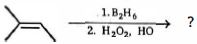
The major product of the following reaction sequence is