MCQ
Configuration of given compound is
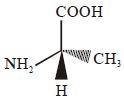
  • A
    $D$
  • B
    $L$
  • C
    $S$
  • both $(B)$ and $(C)$

Answer

Correct option: D.
both $(B)$ and $(C)$
d

Need a full question paper?

Generate a complete, print-ready paper with questions like this in minutes — across 16+ boards, with answer keys.
Start Generating Free

Similar questions

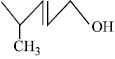
$IUPAC$ name of the below compound is :
When $1\ gm$ equivalent of strong acid reacts with strong base heat released is $13.5\ Kcal$ .  when $1\ gm$ equivalent $H_2A$ is completely neutralised against strong base $13\ Kcal$ is released. When $1\ gm$ equivalent $B(OH)_2$ is  completely neutralised against strong acid $10\ Kcal$ heat is released. Calculate enthalpy change when $1\ mole\ H_2A$ is completely neutralised by $B(OH)_2$........$K\,cal$
The ground state energy of hydrogen atom is $-13.6\, eV$. The energy of second excited state of $He^+$ ion in $eV$ is
Which of the following species has the highest ionisation potential
Given below are two statements :

Statement $(I)$ : The oxidation state of an element in a particular compound is the charge acquired by its atom on the basis of electron gain enthalpy consideration from other atoms in the molecule.

Statement $(II)$ : $\mathrm{p} \pi-\mathrm{p} \pi$ bond formation is more prevalent in second period elements over other periods.

In the light of the above statements, choose the most appropriate answer from the options given below :

Positive ions are formed from the neutral atom by the
What effect is observed, on the size of an atom when an electron is removed and in another case an electron is added to the same atom?
Total number of species from the following which can undergo disproportionation reaction________.

$\mathrm{H}_2 \mathrm{O}_2, \mathrm{ClO}_3^{-}, \mathrm{P}_4, \mathrm{Cl}_2, \mathrm{Ag}, \mathrm{Cu}^{+1}, \mathrm{~F}_2, \mathrm{NO}_2, \mathrm{~K}^{+}$
The solubility product of $Mg{(OH)_2}$ is $1.2 \times {10^{ - 11}}$. The solubility of this compound in gram per $100\,c{m^3}$ of solution is
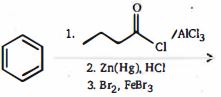
Predict the product of the following reaction.